
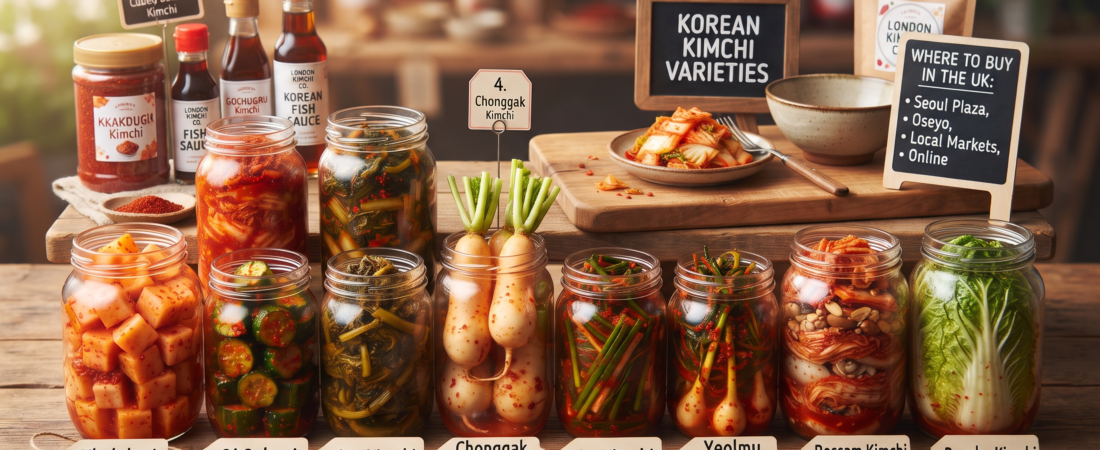
Kimchi is one of the most recognizable foods in Korean cuisine, but there is much more to discover than the familiar spicy napa cabbage version. Across Korea, different vegetables, regional traditions and seasonal ingredients have shaped a wide range of kimchi varieties, each with its own flavour, texture and place at the table.
Some kimchi is spicy, savoury and tangy. Others are mild, crisp and refreshing, with a lightly fermented broth. Certain varieties are traditionally associated with winter, while others are particularly popular during warmer months.
For anyone exploring Korean food in the UK or other regions, understanding these differences is a useful starting point. It can help you choose a kimchi that suits your taste, discover new ways to enjoy vegetables and appreciate the seasonal traditions behind Korean home cooking.
In this guide, we explore eight Korean kimchi varieties, explain how they differ and share practical tips on where to look for them in the UK.
🌟 Key Takeaways
- More than cabbage: Korean kimchi can be made with napa cabbage, radish, cucumber, spring onion, mustard greens and other vegetables.
- Different flavours and textures: Some varieties are spicy and tangy, while others are mild, crisp or served in a refreshing broth.
- Where to buy kimchi in the UK: Korean grocery shops and specialist online retailers are useful places to explore different varieties, although availability varies.
8 Korean Kimchi Varieties
1. Baechu-kimchi (배추김치) – Napa Cabbage Kimchi
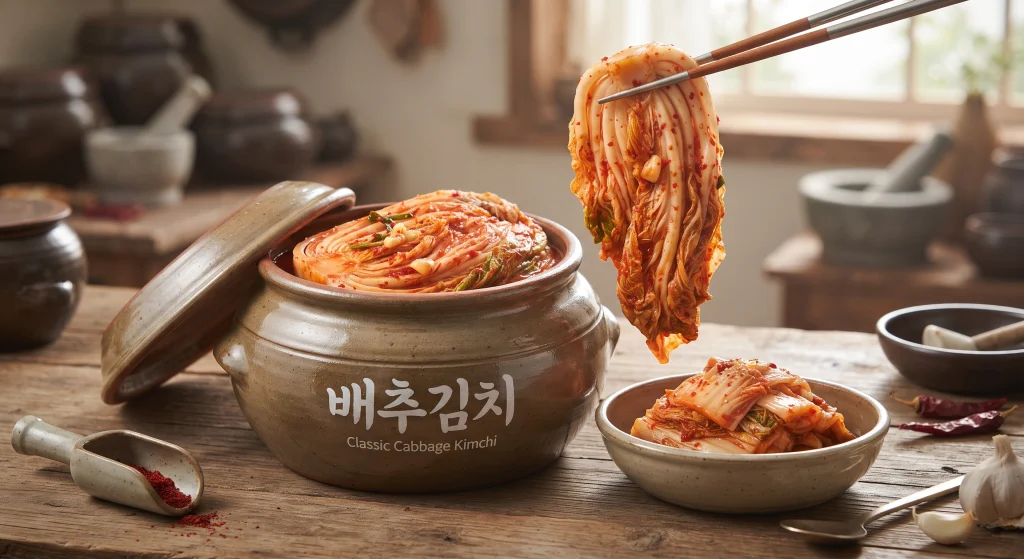
Baechu-kimchi is the classic Korean cabbage kimchi that many people recognise first. It is made with salted napa cabbage, Korean red pepper flakes (gochugaru), garlic, ginger and other seasonings. Depending on the recipe, fish sauce or salted seafood may also be included.
The result is a layered flavour that combines savouriness, gentle heat and a gradually developing tang as the kimchi ferments.
Freshly prepared cabbage kimchi tends to have a firmer texture and a more pronounced seasoning flavour. As fermentation progresses, its acidity becomes more noticeable, making it particularly useful for cooking.
How to enjoy it: Serve it alongside rice, eggs, tofu or a simple vegetable meal. When it becomes more sour, use it in kimchi jjigae, kimchi fried rice or kimchi pancakes.
💡 K-Well’s Tip: Well-fermented kimchi can add depth of flavour to soups and quick weekday meals. Rather than discarding it simply because it has become more acidic, consider using it in a cooked dish, provided it has been stored correctly and remains in good condition.
2. Kkakdugi (깍두기) – Cubed Radish Kimchi
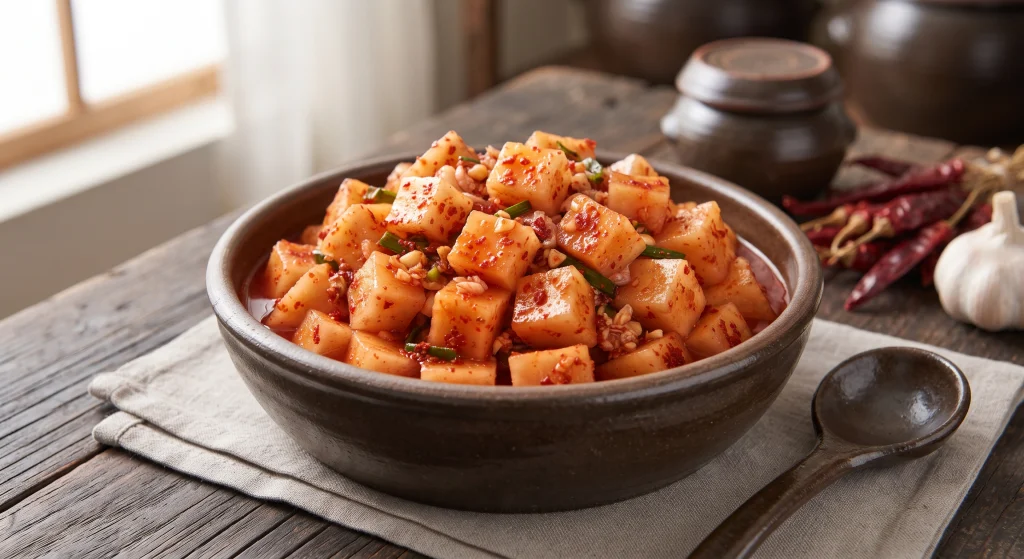
Kkakdugi is made from Korean radish cut into bite-sized cubes and seasoned with a mixture similar to that used for cabbage kimchi.
Its defining feature is its crisp, juicy texture. The radish has a naturally fresh, slightly peppery flavour, while the seasoning adds heat and savouriness. During fermentation, the flavour becomes more complex and tangy.
Kkakdugi is a familiar accompaniment to Korean soups and stews, especially dishes with a rich or comforting broth. Its crunchy texture offers a pleasant contrast to soft rice and tender ingredients.
How to enjoy it: Try kkakdugi with a bowl of rice and soup, or serve it alongside a simple tofu dish.
💡 K-Well’s Tip: If you are new to Korean radish kimchi, start with a small serving alongside a familiar meal. The contrast between its crisp texture and softer ingredients is part of its appeal.
3. Baek-kimchi (백김치) – White Kimchi
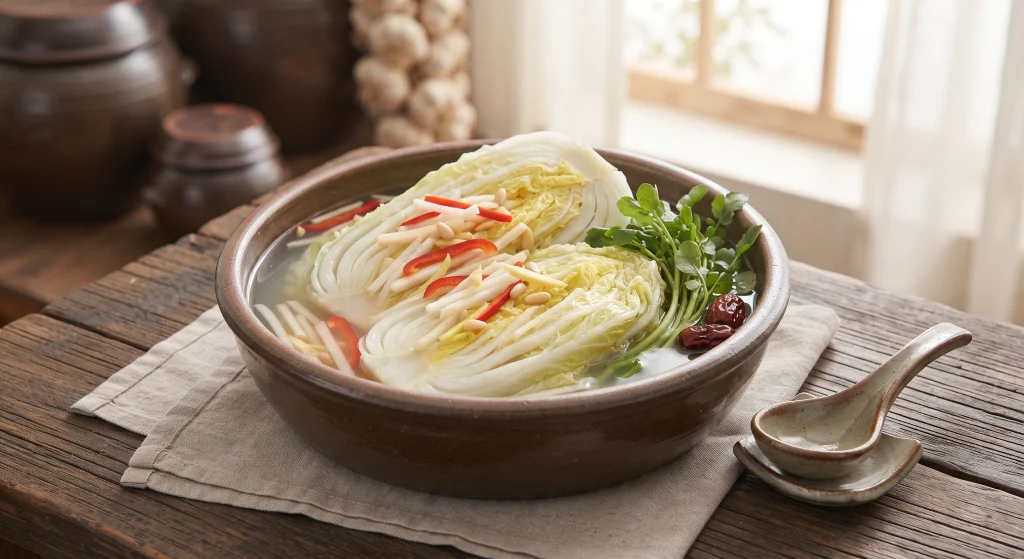
Baek-kimchi is a variety of napa cabbage kimchi prepared without the red pepper powder that gives many familiar kimchi varieties their red colour.
Recipes vary, but common ingredients include garlic, ginger and radish. Some versions also use pear or other fruit. The cabbage is often fermented in a relatively mild brine, creating a flavour that is gentle, fresh and lightly tangy rather than chilli-hot.
Baek-kimchi is a useful introduction for people who are curious about Korean fermented vegetables but prefer to avoid a strong chilli flavour. However, mildness does not necessarily mean that every version is completely non-spicy or suitable for every dietary requirement.
How to enjoy it: Serve it alongside rice, tofu or other Korean dishes. Its lighter flavour can provide a contrast to richer or more strongly seasoned foods.
💡 K-Well’s Tip: Check the ingredient list if you need to avoid fish or seafood. White kimchi is not automatically vegetarian or vegan simply because it contains no red pepper powder.
4. Dongchimi (동치미) – Radish Water Kimchi
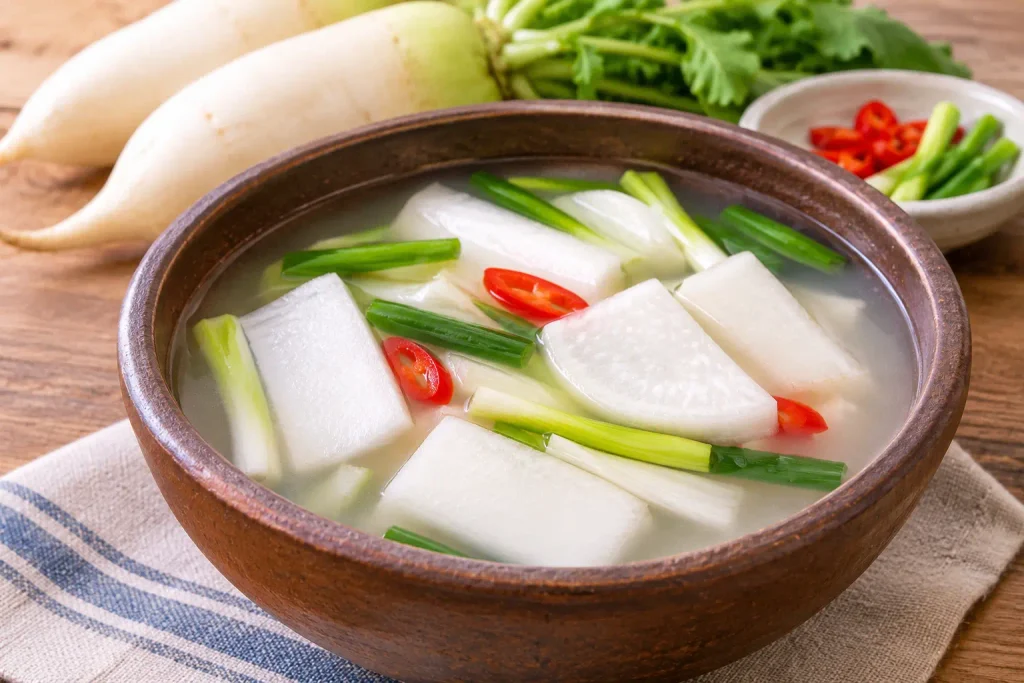
Dongchimi is a traditional water kimchi made primarily with Korean radish in a lightly seasoned brine. Unlike the thick red seasoning associated with many cabbage kimchi recipes, dongchimi is known for its clear or pale broth and refreshing character.
It is particularly associated with winter in Korea. As the radish ferments, the broth develops a distinctive, gently tangy flavour that can be enjoyed alongside a meal.
Dongchimi also illustrates an important feature of Korean kimchi: the liquid can be just as important as the vegetables themselves. The broth is traditionally served and enjoyed rather than treated simply as something to drain away.
How to enjoy it: Serve dongchimi chilled as an accompaniment to rice or other Korean dishes. It can also be enjoyed with certain noodle dishes.
💡 K-Well’s Tip: If you are trying dongchimi for the first time, taste a little of the broth as well as the radish. Both contribute to its distinctive flavour.
5. Oi-sobagi (오이소박이) – Stuffed Cucumber Kimchi
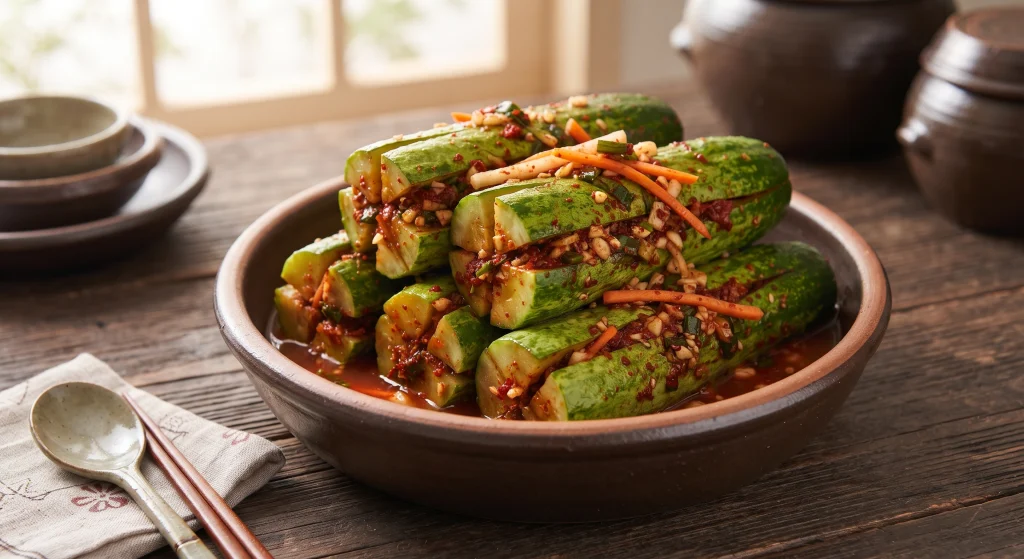
Oi-sobagi is cucumber kimchi made by cutting cucumbers and filling them with a seasoned mixture, often containing garlic, Korean chilli flakes and chopped chives or spring onion.
Unlike cabbage kimchi that is commonly fermented for longer periods, oi-sobagi is often enjoyed while the cucumber is still crisp and fresh-tasting. It is especially associated with spring and summer meals, when a cool, crunchy side dish is welcome.
Cucumber has a high water content, so this variety offers a different texture and eating experience from denser cabbage or radish kimchi.
How to enjoy it: Serve oi-sobagi with rice, noodles or a simple Korean meal. It can also add colour and crunch to a plate of tofu and vegetables.
💡 K-Well’s Tip: Oi-sobagi is best appreciated for its fresh crunch. Follow the recipe or product storage instructions, and do not assume that every cucumber kimchi is intended for long-term fermentation.
6. Yeolmu-kimchi (열무김치) – Young Radish Kimchi
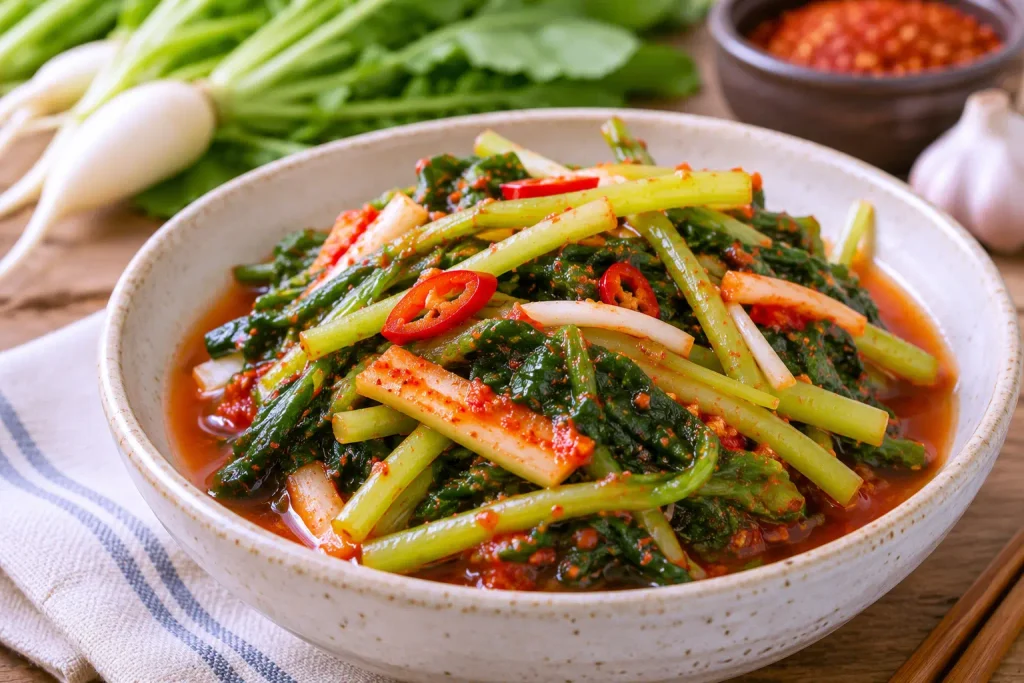
Yeolmu-kimchi is made with young radish greens and their small roots. It is particularly associated with summer, when its lighter, refreshing character suits the season.
The flavour differs from the stronger, more concentrated taste of some mature cabbage kimchi. The greens bring their own fresh, slightly peppery character, while the seasoning adds savouriness and gentle heat.
One well-known way to enjoy yeolmu-kimchi is with Korean noodles or rice. It can be mixed into a bowl of rice with other ingredients, creating a practical meal that combines grains, vegetables and fermented seasoning.
How to enjoy it: Add a small portion to a rice bowl or serve it alongside noodles. For a simple meal, combine rice, yeolmu-kimchi and a selection of fresh or lightly cooked vegetables.
💡 K-Well’s Tip: If you cannot find yeolmu-kimchi in a local shop, look for Korean grocery stores that stock a wider range of refrigerated kimchi. Young radish greens are different from the more familiar large white radish, so check the product name and ingredients.
7. Pa-kimchi (파김치) – Spring Onion Kimchi
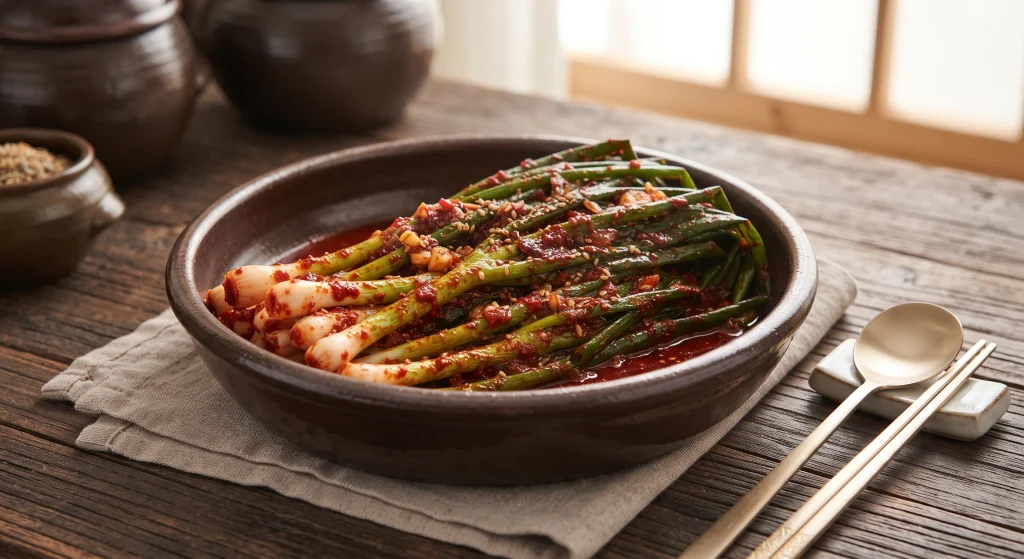
Pa-kimchi is made with spring onions or similar slender Korean onions, seasoned with a mixture that often includes gochugaru, garlic and fermented seafood seasonings.
Its flavour can be quite pronounced. Spring onions have a naturally pungent aroma, and fermentation develops a deeper savoury character. Depending on the recipe and how long it has fermented, pa-kimchi may taste sharp when young and more rounded as it matures.
It is often served in small portions as part of a Korean meal, where its distinctive flavour complements plain rice and other relatively mild dishes.
How to enjoy it: Serve a little pa-kimchi alongside rice, tofu or a simple vegetable-based meal. Its strong flavour means that a small serving can add plenty of character to the plate.
💡 K-Well’s Tip: If you are sensitive to strong onion flavours, begin with a small amount. As with other kimchi varieties, the taste can change during fermentation.
8. Gat-kimchi (갓김치) – Mustard Greens Kimchi
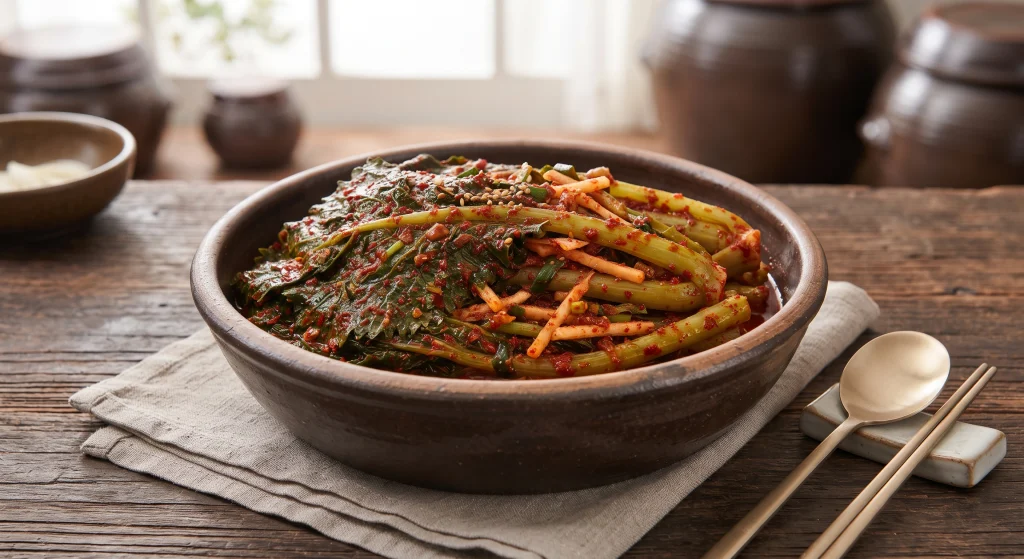
Gat-kimchi is made with mustard greens, which have a distinctive peppery and slightly pungent flavour. It is particularly associated with parts of southern Korea, including the Yeosu area.
Compared with cabbage kimchi, gat-kimchi has a more pronounced leafy character. Its flavour may be earthy, sharp and savoury, making it appealing to people who enjoy vegetables with a stronger taste.
It also demonstrates how Korean kimchi traditions make use of different seasonal vegetables rather than relying on one standard recipe.
How to enjoy it: Serve gat-kimchi with rice and other simple Korean dishes. It can be particularly enjoyable when paired with ingredients that allow its distinctive flavour to stand out.
💡 K-Well’s Tip: Gat-kimchi may be less familiar than cabbage kimchi in UK supermarkets. Korean grocery shops with a broader range of traditional foods are a good place to look.
What Makes These Kimchi Varieties Different?
Although these eight varieties share a place in Korean food culture, their ingredients and preparation methods create different eating experiences.
| Kimchi variety | Main ingredient | Flavour and texture | How it is commonly enjoyed |
| Baechu-kimchi | Napa cabbage | Spicy, savoury and tangy | With rice, or in stews and fried rice |
| Kkakdugi | Korean radish | Crisp, juicy and tangy | With soup, rice and stews |
| Baek-kimchi | Napa cabbage | Mild, fresh and lightly tangy | As a side dish with rice or tofu |
| Dongchimi | Korean radish | Refreshing, with a lightly tangy broth | Alongside meals or with noodles |
| Oi-sobagi | Cucumber | Crisp, juicy and seasoned | With rice and noodle dishes |
| Yeolmu-kimchi | Young radish greens | Fresh, leafy and savoury | With rice or noodles |
| Pa-kimchi | Spring onion | Pungent and deeply savoury | In small portions with rice |
| Gat-kimchi | Mustard greens | Peppery and distinctive | As a side dish with Korean meals |
These are general characteristics rather than fixed rules. Recipes, seasoning levels and fermentation times vary between households, regions and commercial products.
Where to Buy Different Types of Kimchi in the UK
Once you know the differences between Korean kimchi varieties, the next step is finding them. In the UK, Korean grocery shops and specialist online retailers are useful places to start. Mainstream supermarkets may stock familiar cabbage kimchi, but specialist shops can offer a wider selection, depending on their current range.
1. Korean Grocery Shops
Korean supermarkets are a good starting point if you want to explore more than one type of kimchi. Look in the refrigerated section for fresh or chilled products, and check the labels for varieties such as baechu-kimchi, kkakdugi and baek-kimchi.
Two retailers worth exploring are:
- Oseyo: A UK-based Korean and Asian supermarket chain with physical stores across the UK. You can find a range of Korean pantry staples, fresh foods and kimchi products. Product selection and availability may vary by branch.
- Korea Foods or H Mart: Specialist Korean food retailers offering online shopping and, where available, in-store purchases. Their kimchi and pickles selections have included popular varieties such as napa cabbage kimchi and diced radish kimchi (kkakdugi).
If you are visiting a Korean supermarket, ask staff whether they stock cucumber kimchi, young radish kimchi or other varieties that may not be immediately visible on the shelves.
2. What to Look for When Shopping
If you are new to Korean kimchi, start with one familiar variety and one that offers a different flavour or texture.
- For a first introduction: Try napa cabbage kimchi (baechu-kimchi).
- For a crunchy texture: Look for cubed radish kimchi (kkakdugi).
- For a milder flavour without red chilli powder: Try white kimchi (baek-kimchi).
- For a refreshing, broth-based variety: Look for radish water kimchi (dongchimi).
- For a distinctive, peppery flavour: Try mustard greens kimchi (gat-kimchi) if you can find it.
Not every shop will stock all these varieties, and the same type can taste different depending on the recipe and fermentation stage.
It is also worth checking the ingredient list. Some kimchi contain fish sauce, salted shrimp or other seafood ingredients, so vegetarian and vegan shoppers should look for products clearly labelled as suitable for their diet. If you are monitoring your salt intake, compare the nutrition information and choose portions that suit your needs.
💡 K-Well’s Tip: Rather than buying a large tub of an unfamiliar variety, start with a smaller pack if available. Taste it alongside rice, tofu or vegetables, and notice how its flavour and texture differ from the kimchi you already know.
Exploring kimchi this way turns a simple grocery shop into an introduction to the diversity of Korean food culture.
Kimchi and Everyday Wellness
Kimchi can be one way to add variety to a meal, especially when served alongside rice, vegetables, tofu, eggs or other sources of protein. Its different vegetable bases also remind us that Korean food culture includes a much wider range of ingredients than cabbage alone.
However, kimchi should be considered one component of an overall eating pattern rather than a health treatment. Nutritional content varies by recipe and product, and many varieties contain a substantial amount of salt. If you are watching your sodium intake, check the nutrition label and keep portions in line with your needs.
Fermentation is central to the character of many kimchi varieties, but not every product has the same preparation method or live microbial content. Cooking kimchi in a stew or fried rice also changes the food compared with eating it uncooked. It is best to appreciate kimchi for its flavour, versatility and cultural significance without assuming that every variety provides identical health benefits.
For an everyday meal, a modest serving of kimchi alongside vegetables, grains and a suitable protein source can add contrast and flavour without making the entire meal depend on one ingredient.
FAQ
Q1. How many types of kimchi are there in Korea?
There are many regional and seasonal varieties of kimchi, and the total depends on how each type and variation is counted. Napa cabbage kimchi is widely recognised, but radish, cucumber, young greens, spring onions and mustard greens are also used. The eight varieties in this guide are a practical introduction rather than a complete list.
Q2. Which kimchi is best for someone who does not like spicy food?
Baek-kimchi is a useful starting point because it is made without the red chilli powder commonly used in red kimchi. Dongchimi is another option, known for its radish and refreshing broth. However, seasoning varies, so check the ingredients before choosing.
Q3. Is all kimchi vegetarian or vegan?
No. Many traditional recipes include fish sauce, salted shrimp or other seafood ingredients. Some products are made without animal-derived ingredients, but recipes vary. Check the label and look for a clearly labelled vegetarian or vegan option if this matters to you.
Q4. Is kimchi always eaten fresh?
No. Some varieties are enjoyed relatively fresh for their crisp texture, while others are allowed to ferment and develop a more pronounced sourness. The intended fermentation time depends on the ingredients and recipe. Mature kimchi is also commonly used in cooked dishes such as kimchi jjigae and kimchi fried rice.
🌿 K-Well’s Final Thoughts
Kimchi is not just one dish but a collection of traditions shaped by Korea’s four distinct seasons, regional climates, locally available ingredients, fermentation practices and the importance of a balanced everyday diet.
From familiar napa cabbage kimchi to refreshing dongchimi and peppery gat-kimchi, each variety offers a different way to experience Korean food. Some are closely associated with winter, while others are particularly enjoyable during warmer months. Different vegetables, fermentation periods and regional preferences all contribute to the remarkable variety of flavours and textures.
Napa cabbage kimchi remains a familiar staple on Korean dining tables, while other varieties are enjoyed according to personal taste, regional traditions and the dishes they accompany.
Whenever I visit my parents’ home in Korea, I am reminded of how naturally several types of kimchi belong on the same dining table. Each has its own character and purpose, complementing different foods rather than simply serving as another side dish.
For example, pa-kimchi (green onion kimchi), yeolmu-kimchi (young radish kimchi) and gat-kimchi (mustard leaf kimchi) pair particularly well with noodle dishes, adding a bold, savoury and slightly tangy contrast. Baek-kimchi (white kimchi) and dongchimi ( Radish Water Kimchi) are wonderful alongside spicy meals, offering acidity or a refreshing, cooling balance. Kkakdugi (cubed radish kimchi) is a classic companion to Korean soups and stews, while oi-sobagi (stuffed cucumber kimchi) is delicious in its own right, with a distinctive crisp texture and refreshing flavour.
Kimchi also plays two important roles in Korean cooking: it is both an everyday side dish and a versatile ingredient for preparing other meals. Well-fermented napa cabbage kimchi, for instance, can become the foundation of kimchi jjigae, kimchi fried rice or kimchi pancakes.
For readers in the UK, exploring kimchi can begin with something simple: trying a new variety from a Korean grocery shop, learning its Korean name or serving it alongside a familiar home-cooked meal.
You do not need to try every type at once. Start with the flavours and textures you enjoy, then discover how different kimchi varieties complement everyday meals.
Ultimately, the variety of kimchi reflects something fundamental about Korean food culture: making the most of seasonal vegetables, preserving ingredients through fermentation and bringing different flavours together to create a balanced and enjoyable meal. It is a tradition that continues to connect generations, households and everyday dining experiences.
Read Next
- Kimjang: The Korean Tradition of Making and Sharing Kimchi
- 7 Essential Korean Pantry Staples for Beginners in the UK
- 5 Healthy Foods to Buy at Oseyo London: A Korean Grocery Guide
References
• Korea Tourism Organization. Kimchi. https://english.visitkorea.or.kr/svc/contents/infoBscView.do?vcontsId=140728
• UNESCO. Kimjang, Making and Sharing Kimchi in the Republic of Korea. https://ich.unesco.org/en/RL/kimjang-00881