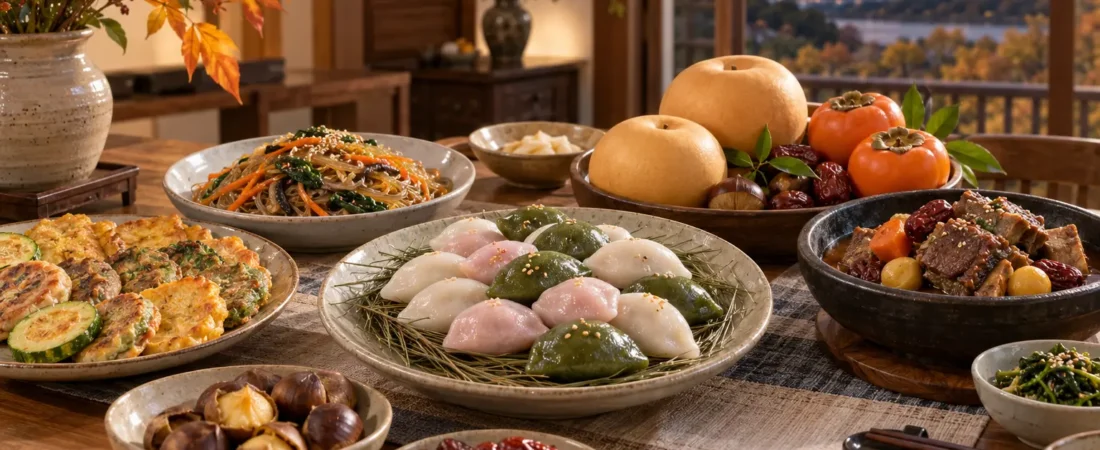
Chuseok (추석) arrives when early autumn begins to settle over Korea. Families travel to spend time together, kitchens fill with the aroma of sesame oil and freshly prepared dishes, and small half-moon rice cakes appear on tables across the country.
Often introduced in English as “Korean Thanksgiving”, Chuseok is more accurately understood as Korea’s major autumn harvest festival. It brings together gratitude for the season, remembrance of ancestors, family reunions and the pleasure of sharing food.
The details are not identical in every household. Some families observe formal ancestral rites, while others focus on visiting relatives, preparing favourite dishes or simply resting together during the national holiday. What connects these different celebrations is a sense of family, seasonal abundance and continuity.
🌟 Key Takeaways
- Korea’s autumn harvest festival: Chuseok falls on the fifteenth day of the eighth lunar month and is one of Korea’s most important traditional holidays.
- Food carries cultural meaning: Songpyeon is the festival’s signature food, while jeon, japchae, meat dishes, seasonal fruit and other family favourites often complete the table.
- Tradition continues to evolve: Ancestral remembrance and regional folk customs remain important, but many modern families celebrate in simpler and more personal ways.
What Does Chuseok Mean?
The name Chuseok can be translated as “autumn evening”. The holiday is also known as Hangawi (한가위), a traditional Korean name associated with the middle of the eighth lunar month and the autumn harvest season.
Chuseok falls on the fifteenth day of the eighth month in the Korean lunar calendar. In South Korea, the official holiday period includes the day before Chuseok, Chuseok itself and the following day, giving families time to travel, gather and observe holiday traditions.
In 2026, the Chuseok holiday runs from 24 to 26 September, with Chuseok itself falling on 25 September. Because Chuseok follows the lunar calendar, its date on the Gregorian calendar changes each year.
Chuseok is sometimes described in English as “Korean Thanksgiving”, but the comparison is only a useful shorthand. The two holidays developed from different histories and traditions. Chuseok is a distinctly Korean harvest festival centred on family homecoming, seasonal foods, remembrance of ancestors and traditions associated with the harvest and full moon.
Why Is Chuseok Celebrated?
Chuseok is traditionally a time to give thanks for the year’s harvest and honour previous generations. Newly harvested rice, fruit and other seasonal foods have long played an important role in the celebration.
Historically, agricultural life made the autumn harvest a particularly meaningful moment. A successful harvest represented food and security for the coming months, so families and communities marked the season with offerings, shared meals, music, dance and games.
Today, most Koreans live in an urban and highly modern society, but the themes of Chuseok remain recognisable:
- returning home or meeting relatives;
- remembering ancestors and family history;
- preparing and sharing special food;
- giving gifts to family, friends or colleagues;
- resting during the national holiday; and
- expressing hopes for health and good fortune.
Chuseok can look different according to a family’s region, religion, circumstances and preferences. It is best understood as a living tradition rather than a single fixed ceremony followed in exactly the same way by everyone.
Traditional Chuseok Customs
Charye: Remembering Ancestors
Some families begin Chuseok with charye (차례), a memorial rite honouring ancestors. Traditionally, carefully prepared foods and seasonal produce are arranged as offerings, and family members bow to show respect.
After the rite, the family shares the food. This practice is known as eumbok (음복) and expresses a connection between remembrance and the family meal.
Not every household performs charye today. Some observe a simplified version, visit relatives or remember loved ones in another personal way. The amount of food and formality can vary considerably.
Seongmyo and Beolcho: Visiting Family Graves
Another long-standing custom is seongmyo (성묘), visiting ancestral graves to pay respects. Families may also carry out beolcho (벌초), clearing grass and tidying the area around a grave, often before the holiday itself.
These practices connect Chuseok with place as well as family. They are one reason so many people travel from Korea’s cities to their ancestral hometowns around the holiday.
The Full Moon
The full moon is one of Chuseok’s most recognisable symbols. Traditionally, people looked at the bright harvest moon and made wishes for their families and the coming year.
The moon also appears in the shape and stories surrounding songpyeon (송편). Although songpyeon is commonly described as a half-moon rice cake, its rounded dough begins like a full moon before being folded around its filling—a visual movement from fullness towards future growth.
Folk Games and Community Traditions
Chuseok was also celebrated beyond the family home through communal performances and games. Customs varied between regions, but familiar examples include:
- Ganggangsullae (강강술래): Women join hands in a circle, singing and moving together under the moon. This harvest tradition from south-western Korea is recognised by UNESCO as Intangible Cultural Heritage.
- Ssireum (씨름): Traditional Korean wrestling competitions are closely associated with holiday gatherings and festivals.
- Yutnori (윷놀이): Families play this traditional board game using four wooden sticks instead of dice.
- Pungmul (풍물) and folk performances: Drumming, dancing and village celebrations traditionally expressed the energy of the harvest season.
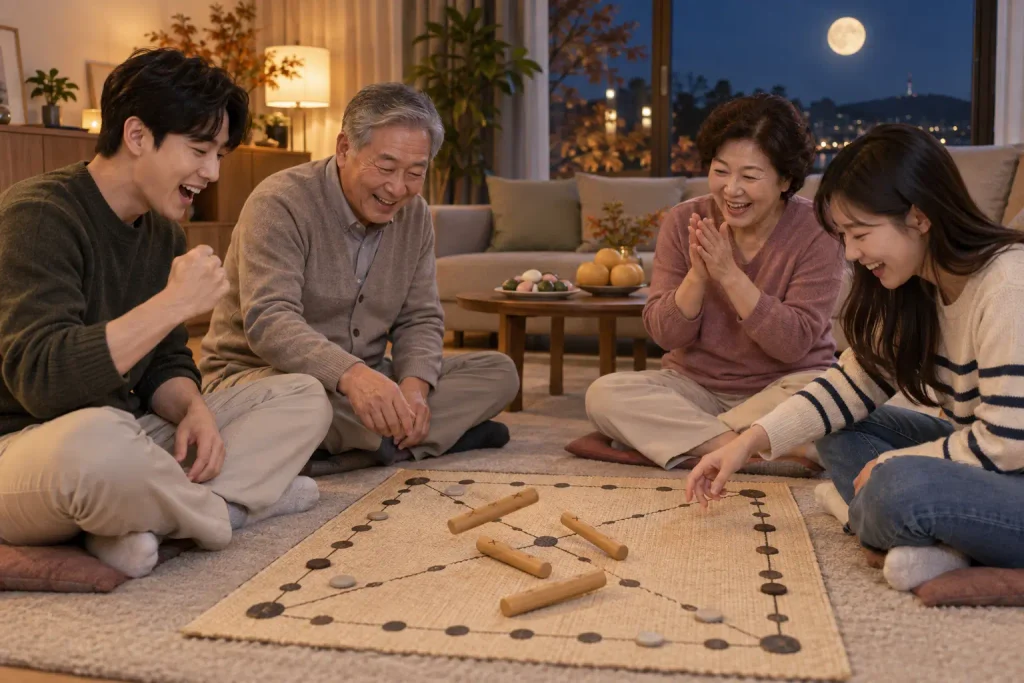
Modern public events at palaces, museums and cultural venues may include performances, craft activities and traditional games, giving visitors another way to experience Chuseok culture.
What Foods Are Eaten During Chuseok?
There is no single menu served by every Korean family. Regional ingredients, household traditions and personal tastes all shape the Chuseok table. Nevertheless, several foods are closely associated with the holiday and with Korean family celebrations more broadly.
Songpyeon: The Signature Chuseok Food
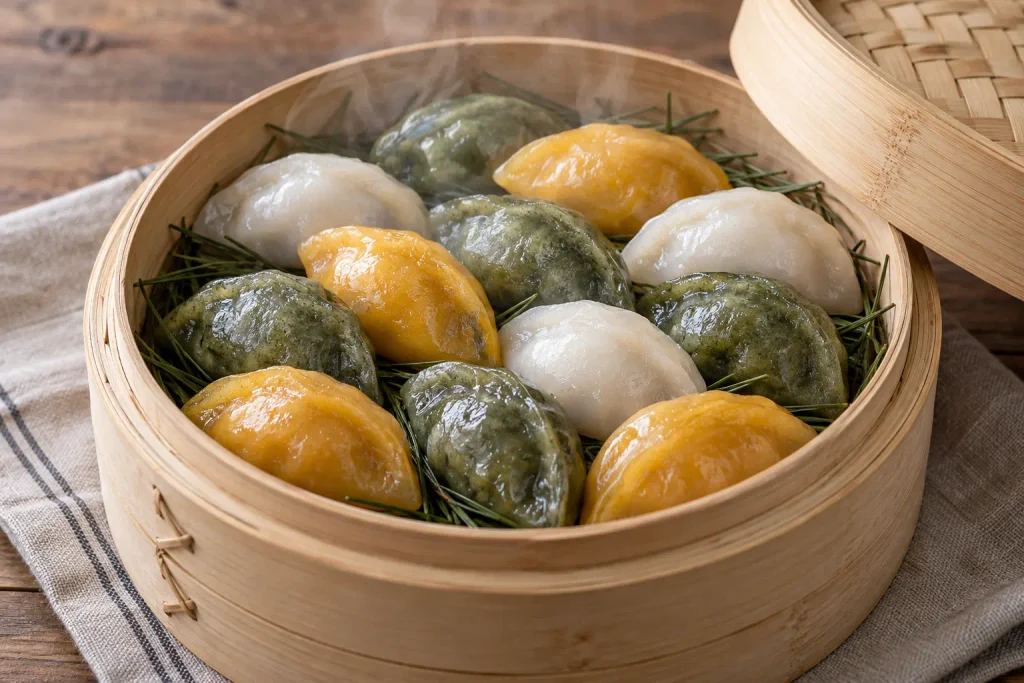
Songpyeon (송편) is perhaps the food most closely associated with Chuseok. These small rice cakes are made by kneading non-glutinous rice flour with hot water, wrapping the dough around a filling and shaping each piece by hand before steaming.
Common fillings include:
- ground sesame seeds mixed with sugar or honey;
- sweetened beans;
- mung beans; and
- chestnuts.
Fillings vary by region and family tradition.
Traditionally, songpyeon can be steamed over pine needles, which give the rice cakes a subtle pine aroma. The name reflects this connection: song refers to pine, while pyeon refers to rice cake.
Making songpyeon can also be a family activity during Chuseok. Each person shapes the cakes by hand, so no two need to look exactly alike. Contemporary versions may use ingredients such as mugwort or pumpkin to create different colours and flavours.
Jeon: Savoury Korean Pancakes
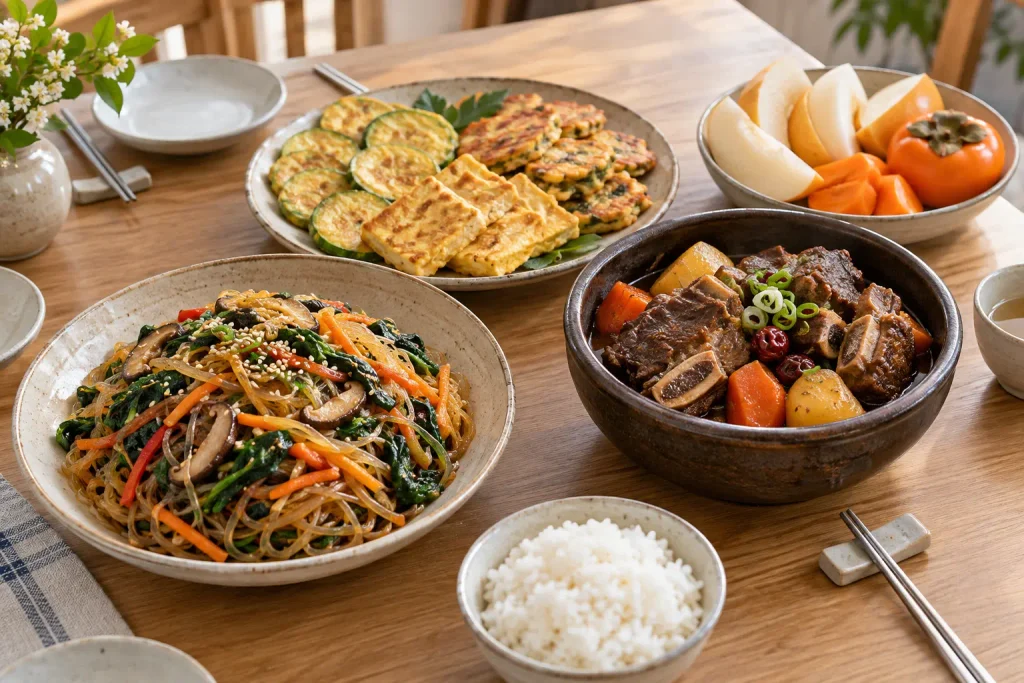
Jeon (전) is a broad category of Korean pan-fried dishes. Some varieties are made by lightly coating individual ingredients in flour and beaten egg before cooking them in a pan, while others combine chopped ingredients with a simple batter.
A Chuseok table may include several varieties, such as:
- Hobakjeon (호박전), made with slices of Korean squash or courgette;
- beoseot jeon (버섯전), made with mushrooms;
- dubu jeon (두부전), made with tofu; or
- Dongtaejeon (동태전), traditionally made with pollack.
- skewered sanjeok (산적) with colourful ingredients.
Preparing several varieties can take time, and the sight, sound and aroma of foods cooking in the kitchen are familiar parts of Korean holiday gatherings. Today, some families simplify the tradition by preparing only a few favourite dishes.
If you enjoy Korean pancakes, Crispy Oil-Free Kimchi Jeon offers an easy version to make at home. Kimchi jeon is not specifically a Chuseok food, but it is a familiar example of Korea’s wider tradition of savoury pancakes.
Japchae: Colourful Noodles for a Celebration
Japchae (잡채) combines sweet potato glass noodles with vegetables and a savoury-sweet soy and sesame seasoning. Mushrooms, spinach, carrots and onions are common additions, and beef is often included, although recipes vary from household to household.
With its colourful ingredients and generous serving style, japchae is popular at holidays, birthdays and family gatherings. For an everyday meal, it can also be adapted with plenty of vegetables and a protein such as tofu, egg or beef to create a more balanced dish.
For a practical plant-based version, try Easy Chuseok Japchae with Tofu and Vegetables.
Galbijjim, Bulgogi and Other Meat Dishes
Celebratory tables may include galbijjim (갈비찜), a dish of beef short ribs slowly braised with a soy-based seasoning, vegetables and aromatics. Bulgogi and other meat dishes may also appear, depending on the household.
These dishes are often associated with hospitality and special occasions, but they are not required parts of every Chuseok meal. Modern celebrations vary widely, and some families may serve just one centrepiece dish alongside rice, vegetables and seasonal fruit rather than preparing an extensive traditional spread.
Rice, Soup and Seasonal Produce
Rice has particular significance during Chuseok because the holiday coincides with the autumn harvest. Newly harvested rice may be enjoyed as part of the seasonal meal, while rice is also the essential ingredient in songpyeon and several other traditional foods and drinks.
For an everyday grain option, Korean multigrain rice, or japgokbap, combines rice with other grains and beans for varied flavour and texture. Japgokbap is not a defining Chuseok food, but it pairs naturally with mushrooms, tofu and other autumn ingredients.
Soups vary by family and region. Toranguk (토란국), a soup made with taro, is particularly associated with Chuseok in some households, while beef soups and other family recipes may also be served.
Seasonal fruits and nuts bring freshness and colour to the holiday table. These may include:
- Korean pears;
- apples;
- persimmons;
- jujubes; and
- freshly harvested chestnuts.
Hangwa and Traditional Drinks
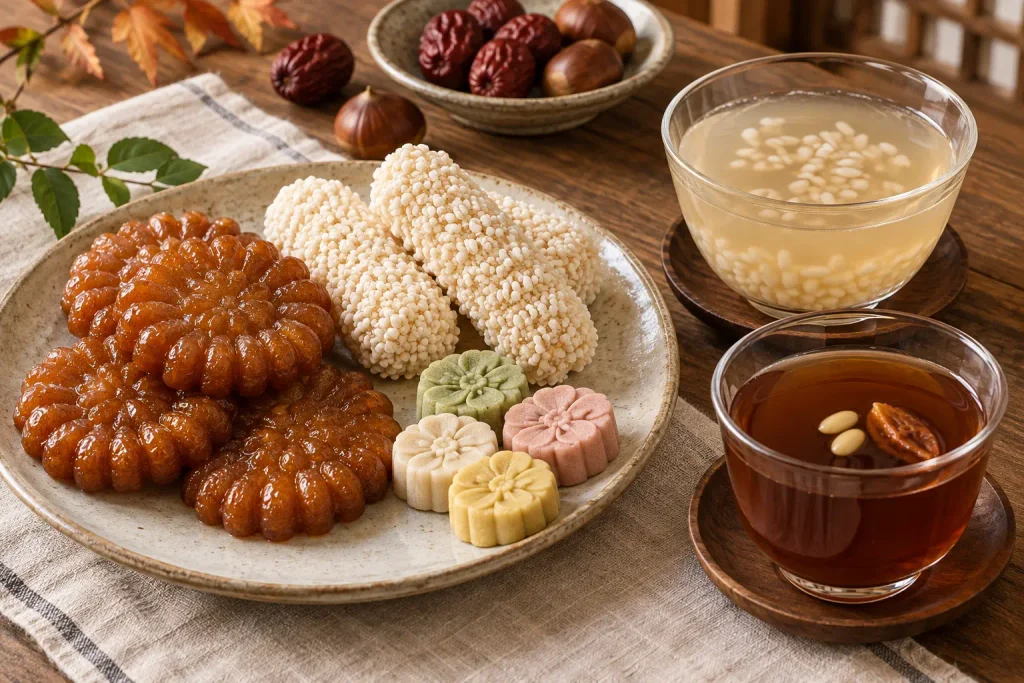
Traditional Korean sweets, collectively known as hangwa (한과), may also be enjoyed during holidays and celebrations. Examples include honeyed yakgwa (약과), light and crisp yugwa (유과), and small pressed sweets called dasik (다식), which are traditionally served with tea.
Popular traditional alcohol-free drinks include sikhye (식혜), a lightly sweet malted rice drink, and sujeonggwa (수정과), a cinnamon-and-ginger punch that may be served with dried persimmon or pine nuts. Tea is another familiar option, while traditional alcoholic drinks may be shared among adults.
As with the rest of the Chuseok table, the selection varies between families and reflects the foods, customs and seasonal ingredients they choose to share.
A More Balanced Way to Build a Chuseok Meal
A traditional holiday table can contain many dishes, but a satisfying Chuseok-inspired meal at home does not need to reproduce an entire ceremonial spread.
Begin with four elements:
- Rice or noodles: Choose rice, japgokbap or japchae.
- A substantial protein: Add tofu, fish, chicken, eggs, beef or beans.
- Seasonal vegetables: Use mushrooms, spinach, courgette, carrots or autumn squash.
- One food with special meaning: Finish the meal with songpyeon, Korean pear or a small traditional sweet.
Fermented seasonings can add distinctly Korean character without requiring numerous sauces. If you are new to them, 3 Essential Korean Fermented Foods: Kimchi, Doenjang and Gochujang explains how these staples differ and how to use them.
This shorter format respects the spirit of sharing a seasonal meal while remaining realistic for a small household or a celebration outside Korea.
💡 K-Well’s Tip: Choose Meaning Over Quantity
You do not need ten different dishes to create a memorable Chuseok meal. Choose one food that carries the festival’s story—such as songpyeon—then add a colourful shared dish, seasonal vegetables and rice.
If friends are joining you, make songpyeon or jeon together. The process of shaping, cooking and sharing the food expresses the communal character of Chuseok more clearly than simply trying to produce the largest possible table.
How to Celebrate Chuseok Outside Korea
You can recognise Chuseok wherever you live, even when specialist ingredients or a large family gathering are not available.
- Prepare one Korean dish and share it with family or friends.
- Make or buy songpyeon from a Korean bakery or supermarket.
- Serve seasonal local fruit alongside Korean tea.
- Call family members who live far away.
- Learn a traditional game such as yutnori.
- Visit a Korean cultural centre, museum or community event.
- Take an evening walk and look for the full moon.
- Talk about family memories or write down a recipe passed through your family.
In the UK, frozen songpyeon, sweet potato noodles, sesame oil and Korean seasonings may be available from Korean or larger East Asian supermarkets. Check opening hours before travelling, particularly around the festival period.
Chuseok in Modern Korea
Chuseok remains a major national holiday, but the way people spend it continues to change. Some travel long distances to see relatives, while others meet for a shorter meal, take a holiday or spend the break at home.
Gift-giving is also highly visible. Fruit, meat, cooking oil, seaweed, health products and practical household goods are commonly presented in decorative sets. The contents reflect both hospitality and the modern retail culture surrounding the holiday.
Holiday travel can be extremely busy as people move between Seoul and regional cities. Visitors to Korea should confirm transport, accommodation and business opening times in advance. At the same time, cultural attractions sometimes provide special programmes that make the holiday an interesting period for learning about Korean traditions.
These modern changes do not make Chuseok less authentic. They show how a long-standing harvest festival adapts to urban life, smaller households and new ways of maintaining family relationships.
FAQ
Q1. When Is Chuseok Celebrated?
Chuseok falls on the fifteenth day of the eighth month in the Korean lunar calendar, so its Gregorian date changes each year. In 2026, Chuseok itself is on 25 September, with the South Korean public holiday running from 24 to 26 September.
Q2. Is Chuseok the Same as American Thanksgiving?
No. Both celebrations can involve gratitude, family and seasonal food, but they developed from different histories and have different customs. “Korean Thanksgiving” is a convenient English introduction; “Korean harvest festival” describes Chuseok more precisely.
Q3. What Is the Most Important Chuseok Food?
Songpyeon is the food most strongly associated with Chuseok. The small rice cakes are commonly shaped like half-moons and filled with ingredients such as sweetened sesame seeds, beans or chestnuts. Other foods vary by region and household.
Q4. Do All Korean Families Perform Ancestral Rites?
No. Charye remains meaningful to many families, but observance differs according to family tradition, religion and personal preference. Some families perform a formal rite, some simplify it, and others celebrate mainly through a shared meal or family visit.
🌿 K-Well’s Final Thoughts
Chuseok is a celebration of more than one harvest meal. It connects food with gratitude, family memory, the changing season and hopes for what comes next.
Songpyeon gives the festival its most recognisable taste, but the wider table reflects Korea’s regional and family diversity. Jeon may sizzle in one kitchen, galbijjim may simmer in another, while a modern household may meet over japchae and fruit before enjoying a quiet holiday afternoon.
Whether you celebrate in Korea or abroad, focus on the heart of the occasion: prepare something seasonal, share it with people who matter and take a moment to appreciate the work and relationships that brought the food to the table.
Read Next
- What Is Japgokbap? Korean Multigrain Rice Guide
- 3 Essential Korean Fermented Foods: Kimchi, Doenjang and Gochujang
- Crispy Oil-Free Kimchi Jeon: Healthy Korean Pancake Recipe
- Easy Chuseok Japchae with Tofu and Vegetables
References
- Korea Customs Service (KCS). Korean National Holidays in 2026. https://www.customs.go.kr/engportal/cm/cntnts/cntntsView.do?cntntsId=7401&mi=13284
- Korea Tourism Organization (KTO). Traditional Korean Holiday of Bountiful Harvest, Chuseok. https://english.visitkorea.or.kr/svc/contents/contentsView.do?vcontsId=231314
- Smithsonian Institution, National Museum of Asian Art. Chuseok. https://asia.si.edu/whats-on/events/celebrations/chuseok/
- United Nations Educational, Scientific and Cultural Organization (UNESCO). Ganggangsullae. https://ich.unesco.org/en/RL/ganggangsullae-00188