Discover Japgokbap, Korean multigrain rice made with grains and beans. Learn its nutrition benefits, blood sugar considerations and how to cook it at home.
Key Takeaways
- More Grain Variety: Japgokbap combines rice with grains and legumes such as barley, millet, black rice and beans, creating more texture and nutritional variety than plain white rice.
- Higher-Fibre Potential: Blends containing whole grains and legumes can provide more fibre than refined white rice, although the exact nutrition depends on the mixture.
- Easy to Adapt: You don’t need to replace white rice completely. Start with a small proportion of Japgok and gradually adjust the mixture to suit your taste and digestion.
The Korean Rice Bowl Is Not Always White
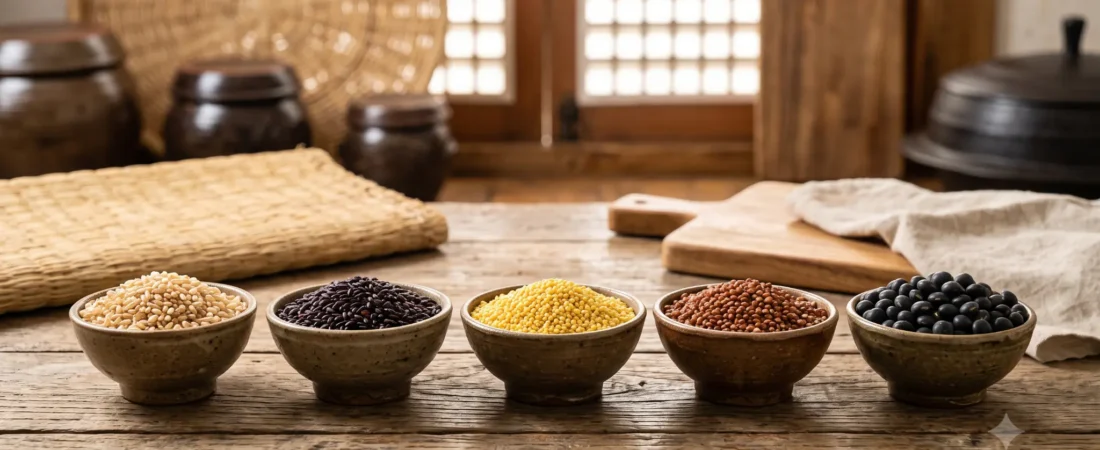
Ask someone to picture Korean food and they may imagine a bowl of steaming white rice beside kimchi, soup and banchan. But open a rice cooker in many Korean homes and you may find something much more colourful. Purple-black grains are scattered between the rice. Small beans add bite. Barley creates a slightly chewy texture, while millet or sorghum brings subtle variation from one spoonful to the next.
This is Japgokbap (잡곡밥). Japgok means mixed grains, while bap means cooked rice or, more broadly, a meal.
Rather than treating rice as a neutral white backdrop, Japgokbap turns the rice bowl itself into an opportunity to eat a wider variety of grains and legumes. For anyone building a Korean-inspired wellness kitchen in the UK, it is also remarkably practical. You can make it in an ordinary rice cooker or saucepan and adjust the grain mixture according to what you enjoy eating.
What Exactly Is Japgokbap?
Japgokbap is not one fixed recipe. It is a broad Korean style of cooking rice together with a mixture of other grains and, frequently, beans.
Depending on the household or commercial blend, you might encounter:
- Brown or black rice
- Barley
- Millet
- Sorghum
- Black soybeans
- Adzuki beans
- other grains and legumes
That variability is one of its strengths. There is no requirement to use ten, fifteen or twenty different grains. A simple bowl containing rice, barley, black rice and beans can still capture the spirit of Japgokbap.
In fact, for beginners, a simpler blend is often easier to cook and more enjoyable to eat.
Why Choose Multigrain Rice Instead of White Rice Every Time?
White rice can absolutely be part of a balanced diet.
The advantage of Japgokbap is not that it transforms rice into a “superfood.” It is that replacing part of a refined grain with whole grains and legumes can increase the variety of plant foods and, depending on the blend, the fibre content of the meal.
Whole grains retain the bran, germ and endosperm, whereas refining removes the bran and germ. The NHS recommends choosing wholegrain or higher-fibre versions of starchy foods where possible because they generally provide more fibre than refined alternatives. That makes Japgokbap a very Korean way to put a familiar nutrition principle into practice.
Instead of giving up rice, you simply change what shares the rice cooker with it.
Japgokbap and Blood Sugar: A More Useful Way to Think About It
This is where multigrain rice is often oversimplified.
Adding whole grains to rice does not guarantee a perfectly flat glucose response, and Japgokbap should not automatically be labelled “low-GI.”
The actual response to a meal depends on several factors, including:
- which grains are included
- how finely they are processed
- the ratio of white rice to whole grains and beans
- cooking method and texture
- portion size
- what you eat alongside the rice
- individual glucose responses
However, there is a useful broader pattern in the research.
A systematic review and meta-analysis of 80 randomised controlled trials found that whole-grain foods, compared with refined-grain foods, produced modestly lower post-meal glucose and insulin responses on average. That does not mean every bowl of Japgokbap will produce the same effect.
It does support a practical principle: replacing some refined grains with less-refined whole grains can be a useful way to improve carbohydrate quality.
For an everyday meal, pair your Japgokbap with vegetables and a source of protein such as tofu, eggs, fish or lean meat rather than focusing on the rice alone.
Fibre: One of Japgokbap’s Most Practical Advantages
One of the clearest differences between refined white rice and many multigrain combinations is fibre. Whole grains retain fibre-rich components that are largely removed during refining, while beans and other pulses can contribute additional fibre. Fibre plays several roles in a balanced diet, including supporting normal bowel function.
The NHS recommends around 30 g of fibre per day for adults and encourages people to obtain it from a variety of foods rather than relying on one ingredient.
Japgokbap can contribute to that bigger picture when it contains meaningful amounts of whole grains and legumes. But check the blend.
A packet marketed as “multigrain” does not necessarily contain the same proportion of whole grains as another product. The ingredient list tells you much more than the number of grains advertised on the front.
K-Well’s Tip: A “20-grain” blend isn’t automatically more nutritious than a simpler five-grain mix. Look at which ingredients appear first and choose grains you will actually enjoy eating regularly.
The Texture Advantage
Nutrition is only half the reason Japgokbap works so well.
The other half is texture. Plain white rice is soft and relatively uniform. Adding barley, millet, black rice and beans creates a bowl that can be chewy, nutty and slightly earthy. This matters because sustainable healthy eating should still be enjoyable.
Black rice can also tint the entire bowl a beautiful purple colour, while beans add contrasting texture. The result feels substantially different from simply switching from white to brown rice.
That sensory variety is one reason Japgokbap has remained part of everyday Korean home cooking rather than existing only as a modern “health food.”
How to Make Japgokbap: The Beginner-Friendly Method
If this is your first attempt, don’t start with 100% mixed grains. A gentler introduction is to keep your familiar rice as the base.
Ingredients
- 1½ cups rice
- ½ cup Korean multigrain mix
- Water according to your rice cooker and grain packet instructions
This gives you roughly a 3:1 rice-to-multigrain ratio.
Once you enjoy the texture, you can experiment with a larger proportion of mixed grains.
Step 1: Check the Grain Mix
Read the packet before cooking. A blend containing small grains may cook relatively easily with rice, while larger beans can require soaking.
Step 2: Rinse
Rinse the rice and grain mixture gently in cool water.
Step 3: Soak When Needed
If your blend contains larger beans or particularly firm grains, soak according to the package directions. This can help the different ingredients cook more evenly.
Step 4: Cook
Transfer everything to your rice cooker and add the appropriate amount of water. If your rice cooker has a multigrain setting, this is a good time to use it.
For stovetop cooking, follow the instructions for your particular blend because different grain combinations absorb water differently.
Step 5: Rest and Fluff
Once cooked, allow the rice to rest briefly before gently fluffing it. You should see individual grains and beans distributed throughout the rice rather than a completely uniform texture.
UK Shopping Guide: What Should You Look For?
If you are shopping at a Korean supermarket such as Oseyo or H Mart, look for packets labelled:
Mixed Grains, Multigrain Mix, Japgok (잡곡), Five-Grain / Mixed-Grain Rice Blend
Rather than automatically choosing the packet with the longest ingredient list, turn it over and read what’s actually inside.
For a beginner-friendly blend, I particularly like the idea of combining:
black rice + barley + millet + beans
It provides enough variety to make the bowl interesting without making cooking unnecessarily complicated.
If Korean multigrain mixes are difficult to find, you can also build your own using grains available in the UK. Just remember that different grains and beans have different soaking and cooking requirements.
How to Build a Balanced Korean Bowl with Japgokbap
Japgokbap becomes most useful when you stop treating it as a wellness ingredient and start treating it as your everyday rice.
Try this simple formula:
Japgokbap + protein + two vegetables + fermented or seasoned side
For example:
Japgokbap + grilled salmon + spinach namul + cucumber + kimchi
or
Japgokbap + tofu + mushrooms + steamed greens + kimchi
or
Japgokbap + egg + courgette + carrots + a small spoonful of gochujang
This approach also helps put carbohydrate quality into context.
Instead of asking whether one type of rice is “good” or “bad,” look at the whole bowl: grain choice, portion, vegetables, protein and seasonings all matter.
Is Japgokbap Good After Exercise?
It can fit very naturally into a post-exercise meal.
Rice and grains provide carbohydrate, while the protein component of the meal can come from tofu, eggs, fish, chicken or another preferred source. Rather than expecting Japgokbap itself to “accelerate muscle recovery,” think of it as the carbohydrate base of a balanced recovery meal.
For example:
Japgokbap + grilled salmon + vegetables
or
Japgokbap + tofu + mushrooms + spinach
can combine carbohydrate, protein and micronutrient-rich plant foods in one satisfying bowl.
After a particularly long or demanding training session, your carbohydrate and fluid needs may be different from those after a short yoga session, so portions can be adjusted accordingly.
Common Japgokbap Mistakes
Using Too Many Grains Too Soon
A very dense mixture can be chewy and unfamiliar if you normally eat white rice. Start gradually.
Ignoring Soaking Instructions
Beans and larger grains may remain hard even when the rice is cooked. Check the packet before putting everything into the rice cooker.
Assuming “Multigrain” Automatically Means Whole Grain
A multigrain product simply contains multiple grains. It does not automatically tell you how much of those grains are whole. Read the ingredient list.
Treating the Rice as the Entire Meal
Japgokbap is still primarily the carbohydrate component of your meal. Build around it with vegetables and an appropriate protein source.
FAQ
Q1. Is Japgokbap healthier than white rice?
Japgokbap made with meaningful amounts of whole grains and legumes can provide more fibre and grain variety than refined white rice alone. However, the nutritional profile depends on the specific mixture and proportions used. White rice can still be part of a balanced diet.
Q2. Is Japgokbap low-GI?
Not necessarily. The glycaemic response depends on the grains, processing, cooking, proportions, portion size and the rest of the meal. Research suggests whole grains generally produce more favourable post-meal glucose responses than comparable refined grains, but that does not make every multigrain rice mixture a low-GI food.
Q3. Do I need a Korean rice cooker?
No. A rice cooker with a multigrain setting is convenient, but Japgokbap can also be prepared in a saucepan. Follow the cooking instructions for your particular grain blend because water requirements vary.
K-Well’s Final Thoughts
Japgokbap offers something more interesting than a simple “brown rice versus white rice” debate. It shows how Korean home cooking can make grain variety part of an ordinary meal.
A handful of barley changes the chew. Black rice adds colour. Millet introduces another whole grain, while beans bring their own texture and nutritional contribution.
You don’t need twenty ingredients or a perfect grain ratio. Start by replacing a small portion of your usual rice with a multigrain blend, find a texture you genuinely enjoy, and build the rest of the bowl with vegetables and protein.
The healthiest kitchen habits are usually the ones that become ordinary enough to repeat.
Read Next
5 Healthy Korean Foods Worth Buying at Oseyo London: A K-Wellness Guide — discover which Korean ingredients are particularly worth adding to your basket when shopping at Oseyo.
References
- National Health Service (NHS). Starchy Foods and Carbohydrates. https://www.nhs.uk/live-well/eat-well/food-types/starchy-foods-and-carbohydrates/
- Harvard T.H. Chan School of Public Health. Whole Grains. https://nutritionsource.hsph.harvard.edu/what-should-you-eat/whole-grains/
- Sanders, L.M. et al. (2023). Whole grain intake, compared to refined grain, improves postprandial glycemia and insulinemia: A systematic review and meta-analysis of randomized controlled trials. Critical Reviews in Food Science and Nutrition, 63(21), 5339–5357. https://pubmed.ncbi.nlm.nih.gov/34930065/
- Ying, T. et al. (2024). Effects of whole grains on glycemic control: A systematic review and dose-response meta-analysis of prospective cohort studies and randomized controlled trials. Nutrition Journal, 23(1), 47. https://pubmed.ncbi.nlm.nih.gov/38664726/