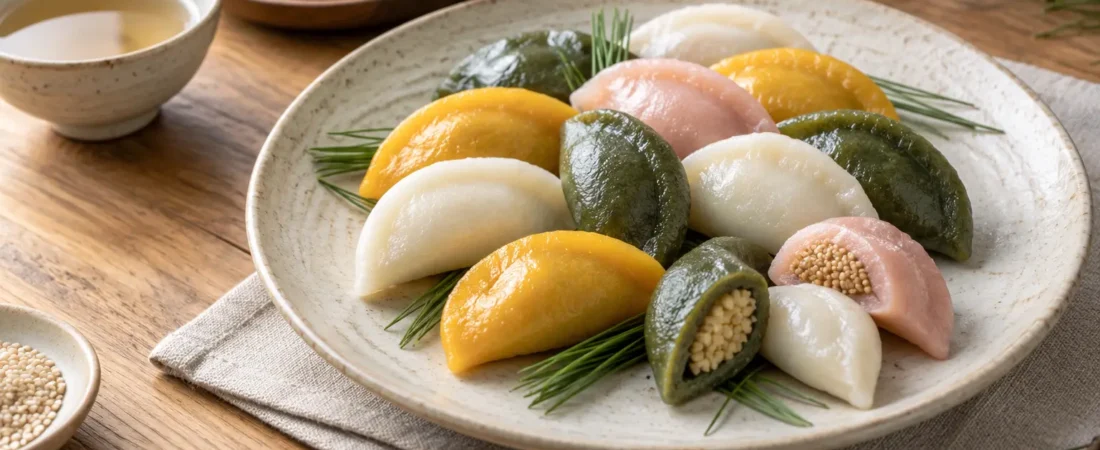
Songpyeon (송편) is a small filled Korean rice cake most closely associated with Chuseok, Korea’s autumn harvest festival. Its soft, chewy rice dough is wrapped around fillings such as sweetened sesame, beans or chestnuts, then traditionally steamed with pine needles.
The best-known songpyeon is shaped like a smooth half-moon. Its mild outer layer gives way to a filling that may be nutty, gently sweet or earthy. Regional crops and shapes vary, so songpyeon is better understood as a family of rice cakes than one fixed recipe.
🌟 Key Takeaways
- Songpyeon is a filled Korean rice cake for Chuseok, usually made with non-glutinous rice flour and shaped into a crescent.
- The taste changes with the filling, from nutty sesame and mild beans to softly sweet chestnuts or pumpkin.
- Regional songpyeon varies in colour, size, dough and shape, reflecting the crops and food traditions of different parts of Korea.
What Is Songpyeon Made From?
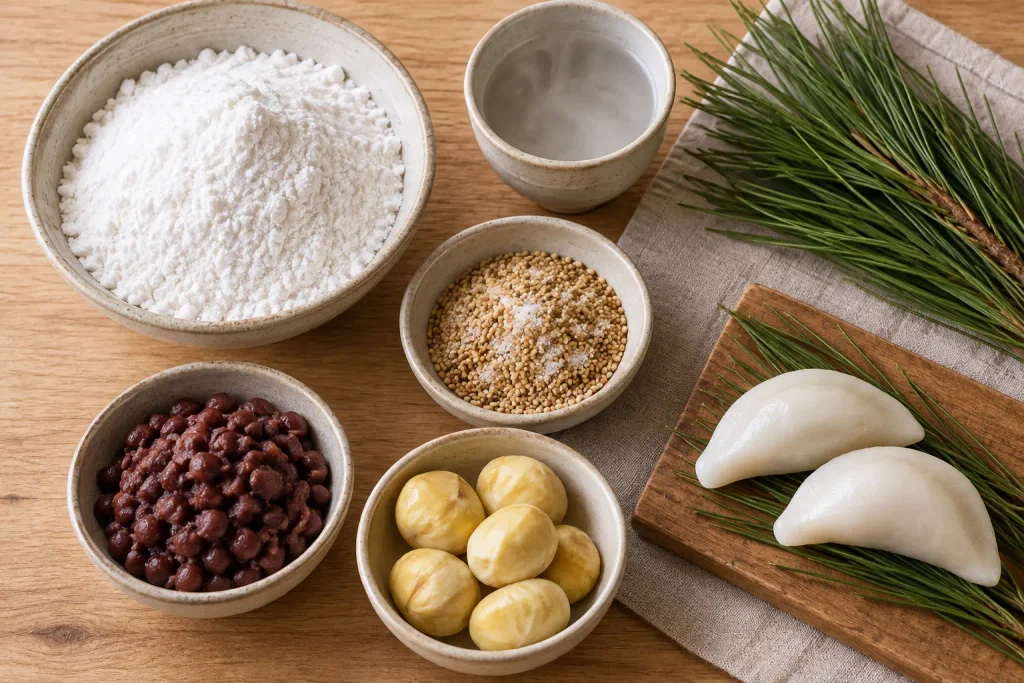
The outer dough is traditionally made from finely ground non-glutinous rice flour mixed with hot water. A small piece is pressed into a cup, filled, sealed and shaped before steaming.
“Non-glutinous” distinguishes ordinary short-grain rice from glutinous or sweet rice; it is not a packaged-food gluten-free certification. Shop-bought products may include other ingredients or face cross-contact, so anyone avoiding gluten should still check the complete label.
The filling provides most of the flavour. Familiar choices include:
| Filling | Flavour | Texture |
| Sesame seeds with sugar or honey | Nutty and gently sweet | Fine and slightly crumbly |
| Sweetened beans or red beans | Mild, earthy and lightly sweet | Soft or slightly textured |
| Mung beans | Subtle and savoury-sweet | Smooth to gently grainy |
| Chestnuts | Naturally sweet and mellow | Soft and starchy |
| Soybeans or peas | Mild and nutty | Soft with a little bite |
Recipes differ between families and producers. Some fillings are noticeably sweet, while others allow the flavour of rice and beans to remain more prominent.
What Does Songpyeon Taste Like?
Fresh songpyeon has a mild rice flavour and a soft, pleasantly chewy bite. It is usually less rich and sugary than a Western cake, with most of its character coming from the centre.
Sesame-filled songpyeon is often the most immediately approachable for a first-time eater because it combines roasted nuttiness with gentle sweetness. Bean fillings taste earthier, while chestnut or pumpkin versions can feel mellow and naturally sweet.
Traditional pine-needle steaming adds a delicate woodland fragrance, while a light coating of sesame oil may give the surface a nutty aroma and gloss. Freshly steamed songpyeon is supple; refrigeration firms the rice starch and makes the texture denser.
How Is Songpyeon Traditionally Made?
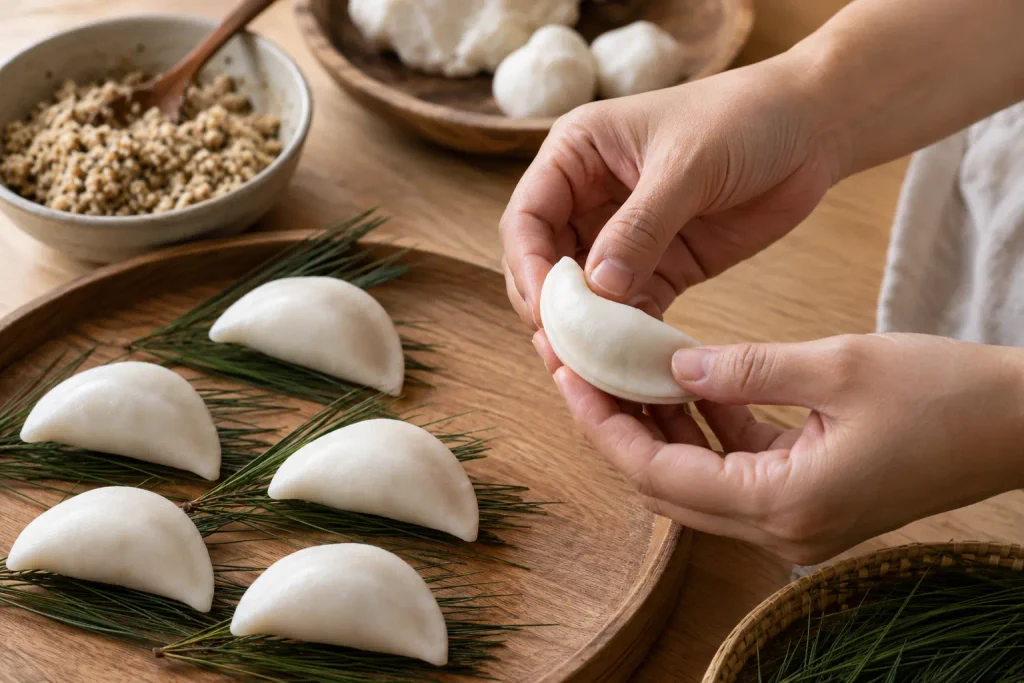
Songpyeon is simple in appearance, but shaping a neat batch takes care. The traditional process can be summarised in five stages:
- Prepare the dough: Finely milled rice flour is mixed with hot water and kneaded until smooth and workable.
- Form a small cup: A piece of dough is rolled and pressed with the thumb to create space for the filling.
- Fill and seal: A modest amount of sesame, bean or chestnut filling is enclosed so that the seam does not open during steaming.
- Shape the crescent: The sealed rice cake is smoothed and curved into a half-moon.
- Steam and finish: The pieces are traditionally layered with pine needles, steamed and lightly coated with sesame oil after cooking.
This is an overview rather than a measured recipe. Freshly milled, frozen-moist and shelf-stable rice flours absorb water differently, so substituting one directly for another can produce cracked or sticky dough.
Why Is Songpyeon Steamed with Pine Needles?
Pine needles contribute fragrance and help separate the rice cakes as they steam. They are also connected to the name: song (송) refers to pine, while pyeon (편) is used for this type of rice cake.
Pine carries cultural associations with longevity and steadfastness, adding another layer of meaning to a food made for an important family holiday. Modern home versions may use a steamer liner when suitable pine needles are unavailable, but the aroma will be different.
Do not cook with unidentified foraged pine. Use needles sold for culinary use or follow a reliable recipe that provides a safe steamer liner alternative.
Why Is Songpyeon Shaped Like a Half-Moon?
The crescent is often interpreted as a form that can continue to grow, giving songpyeon an association with hope and future prosperity. Korean legend also connects the half-moon with the rise of the ancient Silla kingdom.
This article keeps that story brief because the moon symbolism deserves its own explanation. Read The Chuseok Full Moon: Korean Traditions, Wishes and the Meaning of Songpyeon for the Baekje–Silla legend, full-moon wishes and the relationship between the round festival moon and the crescent rice cake.
Why Is Songpyeon Eaten at Chuseok?
Traditionally made with newly harvested rice and seasonal fillings, songpyeon expresses gratitude for the year’s crops. During charye, an ancestral memorial rite observed by some families, it may be included among food offerings before the dishes are shared. Other households buy it from a rice-cake shop for a less formal meal.
For more about the festival beyond this one food, read What Is Chuseok? Korean Harvest Festival Foods and Traditions.
Regional Songpyeon Varieties Across Korea
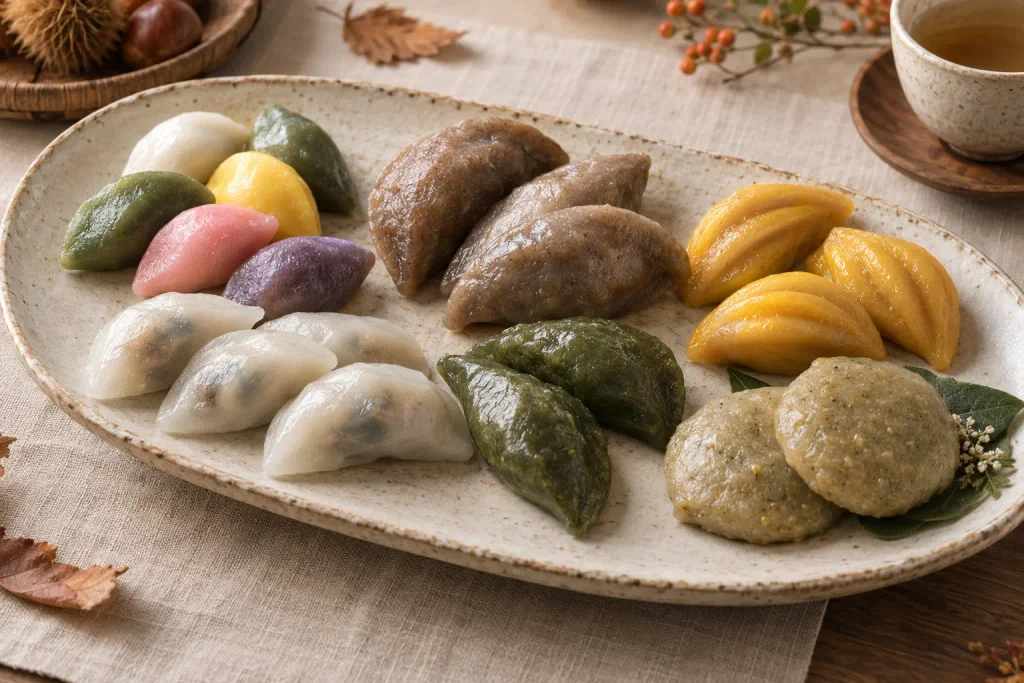
The familiar small crescent is only one expression of songpyeon. Regional versions reflect local crops, climate and preferences.
| Region | Recognisable style | What makes it different |
| Seoul | Osaek songpyeon | Small crescents in five colours |
| Chungcheong-do | Hobak songpyeon | Pumpkin colours and flavours the dough |
| Jeolla-do | Flower or mosi songpyeon | Decorative natural colours or ramie-leaf dough |
| Gyeongsang-do | Chik songpyeon | Arrowroot adds an earthy aroma and flavour |
| Gangwon-do | Potato songpyeon | Potato creates a characteristically chewy dough |
| Jeju | Wandukong songpyeon | A flatter, round shape with sweetened pea or bean filling |
These variations show why one photograph cannot define every authentic songpyeon. Colour, size, filling and even the expected crescent shape may change according to place.
How Does Songpyeon Compare with Chapssaltteok, Mochi and Mooncakes?
These foods share connections with rice, celebration and a pleasantly chewy or filled texture, while each has its own ingredients and preparation.
| Food | Main base | Typical preparation | Familiar form |
| Korean songpyeon | Usually non-glutinous rice flour | Filled, shaped and steamed | Small crescent, with regional exceptions |
| Korean chapssaltteok | Glutinous rice or sweet rice flour | Commonly formed around a sweet red bean filling | Usually round |
| Japanese mochi | Glutinous rice or glutinous rice flour | Pounded or formed into many styles | Plain or filled; shapes vary |
| Chinese mooncake | Usually a baked pastry skin, although styles vary | Moulded around a dense filling | Round cake with a patterned top |
For readers familiar with mochi, chapssaltteok (찹쌀떡) offers the closest Korean comparison because it is made with glutinous rice and is often filled with sweet red bean paste. Songpyeon has a character of its own: non-glutinous rice flour creates its soft, gently chewy shell, while seasonal fillings, crescent shaping and traditional pine-needle steaming connect it closely with Chuseok.
How to Buy Songpyeon in the UK
In the UK, songpyeon is most likely to appear at Korean supermarkets, rice-cake shops and larger East Asian grocers around Chuseok. Availability changes by shop and season, so check current stock before travelling.
Look in the chilled or frozen section and check for the Korean name 송편, the Romanised name songpyeon, or the description half-moon rice cake. Before buying, check:
- whether the product is fresh, chilled or frozen;
- the filling and sweetness level;
- sesame, soya and any other allergen information;
- whether honey or another animal-derived ingredient is used;
- the use-by date and storage instructions; and
- whether it should be steamed, microwaved or thawed before serving.
Frozen songpyeon is practical when fresh rice cakes are unavailable, but preparation varies. Follow the packet rather than assuming every product is thawed or reheated in the same way.
Dietary and Allergen Notes
Songpyeon is not automatically vegan, gluten-free or suitable for every allergy. Sesame and soya are common, some products contain nuts or peanuts, and honey may sweeten a filling. Rice flour itself does not contain wheat gluten, but added ingredients and manufacturing environments differ.
Read the label every time, especially when buying a mixed-colour or assorted pack in which each piece may contain a different filling.
How to Store and Reheat Songpyeon
Songpyeon is best when fresh. Cool and store homemade rice cakes promptly, follow the instructions supplied with shop-bought products and do not use appearance or smell alone to judge food safety.
Refrigeration can make the rice dough firm. If the product instructions allow reheating, gentle steaming usually restores moisture more evenly than prolonged dry heating. A microwave may work for some packaged products, but use short intervals and cover the rice cakes as directed so they do not become tough.
For longer storage, freeze only when the recipe or manufacturer recommends it, dividing the pieces so you can reheat only what you intend to eat.
💡 K-Well’s Tip
For a first tasting, choose a small assorted pack rather than a large quantity of one filling. Warm only a few pieces according to the label, then compare sesame, bean and chestnut while the dough is soft.
Serve songpyeon after a simple shared meal rather than treating it like a large Western dessert. Easy Chuseok Japchae with Tofu and Vegetables provides a colourful main dish, while Korean tea or fresh pear makes a light accompaniment to the rice cakes.
FAQ
Q1. Is Songpyeon Sweet or Savoury?
Most songpyeon is mildly sweet, but the flavour depends on the filling. Sesame with sugar or honey tastes nutty and sweet, while beans, peas and chestnuts can be earthier and less dessert-like.
Q2. Is Songpyeon Made with Glutinous Rice Flour?
Traditional songpyeon is generally made with non-glutinous rice flour rather than the glutinous or sweet rice used for many mochi styles. Recipes vary, however, and some modern versions may blend flours to change the texture.
Q3. Can You Eat Songpyeon Cold?
It can be served at room temperature, but chilled songpyeon often becomes firm. Follow the package directions for warming or thawing; freshly steamed or gently reheated pieces usually have the softest texture.
Q4. Can I Buy Songpyeon Outside Chuseok?
Sometimes. Korean rice-cake shops may sell it at other times, and frozen products can appear year-round. Choice is usually widest around Chuseok, but availability varies by retailer.
🌿 K-Well’s Final Thoughts
Songpyeon is easy to recognise by its half-moon shape, but its character comes from more than appearance. Mild rice dough, contrasting fillings, pine fragrance and regional ingredients give each variety a distinct identity.
Start with the practical details: choose a filling you will enjoy, check how the product should be stored and warm it carefully so the dough stays soft. Then look beyond the first bite. Songpyeon connects Korea’s autumn harvest with family skill, local crops and the pleasure of sharing a small but meaningful food.
Read Next
- What Is Chuseok? Korean Harvest Festival Foods and Traditions
- The Chuseok Full Moon: Korean Traditions, Wishes and the Meaning of Songpyeon
- Easy Chuseok Japchae with Tofu and Vegetables
References
• Korea Tourism Organization (KTO). Traditional Korean Holiday of Bountiful Harvest, Chuseok. https://english.visitkorea.or.kr/svc/contents/contentsView.do?vcontsId=231314
• Ministry of Culture, Sports and Tourism (MCST). Songpyeon: The crescent-shaped soul of Korean culture. https://www.mcst.go.kr/english/policy/kocis/newsView.jsp?pSeq=266
• Korean Food Promotion Institute (KFPI). Where does this Songpyeon come from? https://www.hansik.or.kr/magazines/list/magazineDetail/16/2863?menuSn=429
• Food Standards Agency (FSA). Home food fact checker. https://www.food.gov.uk/safety-hygiene/home-food-fact-checker