
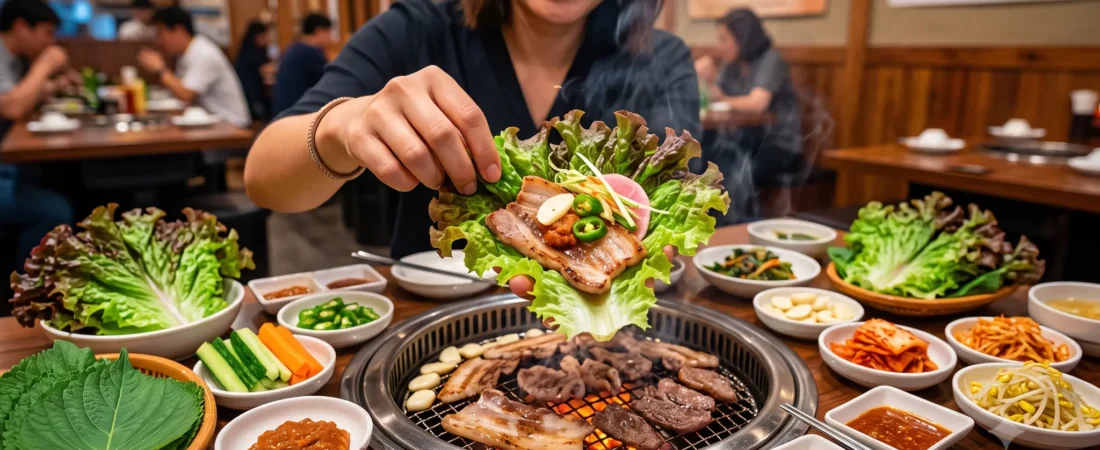
Learn how to build Korean BBQ Ssam with lettuce, perilla leaves, grilled meat and homemade Ssamjang, plus practical ingredient tips for UK kitchens.
Key Takeaways
- Choose leaves for flavour and texture: Soft lettuce folds easily, perilla adds a distinctive herbal note, and napa cabbage provides extra crunch.
- Keep each wrap bite-sized: A small amount of meat, rice, vegetables and Ssamjang creates a neater wrap with a better balance of flavours.
- Adjust the sauce to your taste: Commercial Ssamjang products vary in sweetness and saltiness, while a simple homemade version lets you control both.
What Is Ssam?
Ssam (쌈) means “wrapped” in Korean. At a Korean barbecue table, it usually refers to a leaf filled with grilled meat and small accompaniments such as rice, garlic, chilli and Ssamjang. The entire parcel is folded and traditionally eaten in one bite.
Ssam is not a rigid recipe. It is a flexible way of eating that allows everyone at the table to create a different combination with each mouthful. One wrap might contain pork belly and raw garlic; the next might combine beef, rice, kimchi and a perilla leaf. Vegetarian fillings such as mushrooms, tofu and grilled aubergine also work well.
The appeal lies in the contrast: hot grilled food against cool leaves, rich meat against fresh vegetables, and savoury Ssamjang against the clean crunch of lettuce. It also turns dinner into a social, hands-on experience rather than a meal assembled in advance.
The Best Leaves for Korean BBQ Ssam
Korean barbecue restaurants often serve more than one type of leaf. Each offers a different flavour, texture and wrapping style.
Red or Green Leaf Lettuce (Sangchu, 상추)
Leaf lettuce is the easiest option for beginners. Its broad, flexible leaves fold neatly around meat and rice without cracking. Red leaf lettuce has slightly more colour, while green leaf lettuce usually tastes mild and fresh.
Choose leaves that look crisp rather than wilted. Wash them thoroughly, spin or pat them dry and keep them chilled until serving. Excess water can dilute the sauce and make the wrap slippery.
Perilla Leaves (Kkaennip, 깻잎)
Korean perilla leaves have serrated edges and a strong herbal aroma. Their flavour is often described as a combination of mint, basil and anise, although it is distinctly its own. Perilla pairs especially well with grilled pork, garlic and fermented sauces.
The leaves are smaller and firmer than lettuce, so they can be used alone for a compact wrap or layered inside a larger lettuce leaf. If the central stem feels tough, trim the thickest part before serving.
In the UK, fresh perilla leaves are most likely to be found in Korean supermarkets and larger East Asian grocers. Availability varies by branch and season, so check online or contact the shop before making a special journey.
Napa Cabbage (Baechu, 배추)
The pale inner leaves of napa cabbage are crisp, lightly sweet and sturdy enough to hold heavier fillings. Raw leaves provide plenty of crunch, while briefly salted or blanched leaves become softer and easier to fold.
Napa cabbage is widely available in UK supermarkets, although it may be labelled Chinese leaf or Chinese cabbage.
Other Practical UK Options
If Korean greens are unavailable, try:
- Little Gem lettuce for compact, crunchy cups
- Butterhead lettuce for soft, flexible wraps
- Romaine hearts for a firmer texture
- Savoy cabbage leaves, briefly blanched and cooled
These substitutes will not taste exactly the same as Korean perilla or sangchu, but they still work well as edible wraps.
Nutrition and Meal Balance
Why Pair Korean BBQ with Vegetables?
Eating Korean barbecue with lettuce, perilla leaves and other vegetables creates a more nutritionally varied meal than eating grilled meat alone. Meat provides protein, iron, zinc and vitamin B12, while the vegetables add fibre, water and micronutrients such as folate and vitamins C and K.
Vegetable wraps also add freshness and volume to each bite, helping to create a more balanced plate. However, the overall nutritional value still depends on the type and amount of meat, cooking method, rice portions and sauces served alongside it. Fatty cuts such as pork belly and sodium-rich Ssamjang are best enjoyed in sensible portions as part of a varied diet.
Nutritional Snapshot of Common Ssam Leaves
Ssam leaves add freshness, texture and vegetable variety to the meal, along with fibre and a range of micronutrients that vary by leaf type.
| Leaf | Nutrients commonly found | Practical note |
| Leaf lettuce (Sangchu) | Vitamin K, folate, carotenoids and water | Adds freshness and volume with relatively little energy |
| Perilla leaves (Kkaennip) | Fibre, micronutrients and naturally occurring plant compounds | Published values vary by variety and source, so it is better treated as a flavourful vegetable than as a supplement |
| Napa cabbage (Baechu) | Vitamin C, vitamin K, folate and water | Adds crunch and works well as a fresh vegetable wrapper |
| Little Gem or romaine lettuce | Vitamin K, folate, carotenoids and water | A widely available UK alternative with firm leaves |
USDA FoodData Central provides composition data for raw green and red leaf lettuce and napa cabbage. These figures are useful for general comparison, but the actual values—and the amount eaten in a few wraps—will vary.
What to Put Inside a Ssam
A good Ssam does not need many ingredients. In fact, overfilling makes it difficult to fold and can hide the flavour of the grilled food.
1. Grilled Protein or Vegetables
Popular Korean barbecue fillings include:
- Samgyeopsal (삼겹살) : unseasoned slices of pork belly
- Chadolbagi (차돌바기) : thinly sliced beef brisket
- Bulgogi (불고기) : marinated beef
- Dak-gui (닭고기): grilled chicken
- Firm tofu, pressed and grilled
- King oyster mushrooms or portobello mushrooms
- Grilled aubergine or courgette
Marinated meat is usually sweeter than unseasoned cuts, so taste it before adding a large amount of sauce. The aim is to combine flavours, not cover every ingredient with Ssamjang.
2. Rice
Rice is optional, but a small spoonful makes the wrap more substantial and is common at many Korean meals. Short-grain white rice has the most traditional sticky texture, while brown rice or mixed-grain rice offers a nuttier flavour.
Use about one or two teaspoons per wrap. Too much rice makes the leaf difficult to close.
K-Well’s Tip: For a lower-carbohydrate option, skip the rice and add extra vegetables, tofu or mushrooms instead.
3. Garlic and Chilli
A thin slice of raw garlic adds a sharp bite, while grilled garlic tastes softer and sweeter. Mild green chilli brings freshness and heat. Both are optional, particularly for anyone who finds raw garlic or chilli uncomfortable.
4. Kimchi (김치) and Other Banchan (반찬)
A small piece of kimchi, seasoned spring onion salad or pickled radish can add acidity and crunch. Drain very wet side dishes before placing them in the leaf so the wrap does not fall apart.
5. Ssamjang
Ssamjang (쌈장) is a thick, savoury dipping paste commonly served with Ssam. It is usually made with Doenjang, Gochujang and seasonings such as garlic, sesame oil and sesame seeds.
Because Doenjang, Gochujang and commercial Ssamjang can be salty, a small amount is normally enough. Begin with half a teaspoon and add more only if needed.
If you are new to Korean fermented seasonings, discover further insights on Korean fermented foods and explore this Korean pantry essentials guide to learn how to use Doenjang, Gochujang and sesame oil.
Easy Homemade Ssamjang
This simple version makes enough for approximately four servings. It is savoury, gently spicy and easy to adjust.
Makes: About 6 tablespoons
Prep time: 5 minutes
Ingredients
- 2 tablespoons Doenjang
- 1 tablespoon Gochujang
- 1 teaspoon toasted sesame oil
- 1 teaspoon toasted sesame seeds
- 1 small garlic clove, finely grated
- 1 teaspoon rice syrup, honey or sugar (optional)
- 1–2 tablespoons water, as needed
- 1 tablespoon finely chopped spring onion (optional)
Method
- Place the Doenjang, Gochujang, sesame oil, sesame seeds and garlic in a small bowl.
- Add the optional sweetener if you prefer a rounder, less salty flavour.
- Stir in one tablespoon of water. Add a little more if the sauce is too thick to spoon easily.
- Fold in the spring onion, taste and adjust gradually.
- Cover and refrigerate until serving.
Store leftovers in a clean, airtight container in the refrigerator and use within three days. Always follow the storage instructions on the Doenjang and Gochujang packaging.
Commercial Ssamjang vs Homemade Ssamjang
Commercial Ssamjang is convenient and can be a useful pantry staple. Products vary, so the best choice depends on your taste and dietary requirements rather than one ingredient alone.
| Option | What to check | Practical tip |
| Commercial Ssamjang | Sugar, salt, allergens and recommended serving size | Compare labels and begin with a small spoonful |
| Homemade Ssamjang | The saltiness of your Doenjang and heat of your Gochujang | Add water and sweetness gradually after tasting |
| Sesame oil dip | Sesame oil, salt and black pepper | Use sparingly alongside other salty sauces |
Note: Ssamjang usually contains fermented soya, and some products also contain wheat. Anyone with a food allergy or intolerance should check the complete ingredient list rather than relying on the product name.
How to Assemble a Korean BBQ Ssam
Step 1: Choose the Leaf
Place one dry lettuce leaf in your palm. Add a perilla leaf on top if you enjoy its herbal flavour. Trim or fold any large stems that make the wrap difficult to close.
Step 2: Add a Small Main Filling
Place one modest piece of cooked meat, tofu or mushroom in the centre. Cutting large pieces before serving makes the wraps easier to assemble.
Step 3: Add Rice and Vegetables
Add one or two teaspoons of rice if desired, followed by a thin slice of garlic, chilli or a small piece of kimchi. Avoid piling every available side dish into the same leaf.
Step 4: Finish with Ssamjang or Sesame oil dip
Add about half a teaspoon of Ssamjang. Taste your first wrap before deciding whether the next one needs more sauce. Alternatively, you may include a sesame oil dipping sauce according to your preference.
Step 5: Fold and Eat
Fold the sides of the leaf towards the centre and tuck the bottom upwards to create a compact parcel. Ssam is traditionally eaten in one mouthful, so reduce the filling if it feels too large.
A Simple Korean BBQ Ssam Platter for Four
For an easy meal at home, prepare:
- 2 heads leaf lettuce or 3 Little Gem lettuces
- 20–30 perilla leaves, if available
- 600–800g meat, tofu, mushrooms or a combination
- 2 cups cooked rice
- 1 batch homemade Ssamjang
- 1 small dish sliced garlic
- 1 small dish sliced green chilli
- Kimchi or pickled radish
- Spring onion salad (optional)
This is a flexible serving guide rather than a fixed rule. Adjust the quantities according to appetite, side dishes and the mix of meat and vegetables.
Vegetarian and Vegan Ssam Ideas
Ssam works just as well without meat. Try these combinations:
- Grilled king oyster mushroom, rice and Ssamjang
- Crisp tofu, kimchi and spring onion
- Grilled aubergine, garlic and sesame seeds
- Courgette, mushroom and pickled radish
- Tempeh, lettuce and mild Gochujang sauce
For a vegan meal, check that the kimchi, Doenjang, Gochujang and Ssamjang do not contain fish sauce, shrimp or other animal-derived ingredients.
Where to Buy Ssam Ingredients in the UK
Lettuce, napa cabbage, garlic, chilli, mushrooms, tofu and sesame oil are available from most large UK supermarkets. Doenjang, Gochujang and ready-made Ssamjang may be stocked in larger world-food sections, but Korean and East Asian supermarkets generally offer a wider selection.
Fresh perilla leaves are less widely available. Look in the chilled produce section of Korean supermarkets such as H Mart or Oseyo, or check independent East Asian grocers and online Korean food shops. Stock and prices vary, so confirm availability before travelling.
When comparing sauces, consider:
- How spicy or sweet you want the sauce to be
- Salt per serving
- Soya, wheat or sesame allergens
- Whether a product is vegan
- Pack size and how often you will use it
Food-Safety Tips for Korean BBQ at Home
Raw meat and ready-to-eat leaves should be kept separate.
- Use separate plates and utensils for raw and cooked meat.
- Do not place cooked food back onto a plate that holds raw meat.
- Wash hands after touching raw meat.
- Keep lettuce and perilla refrigerated until shortly before serving.
- Follow current UK guidance for safe cooking temperatures and storage.
- Refrigerate leftovers promptly and use them within the recommended period.
These simple steps are particularly important at tabletop barbecues, where several people may be handling ingredients and utensils.
FAQ
Q1. Is Ssam always made with lettuce?
No. Lettuce is common, but Korean Ssam can also use perilla leaves, napa cabbage, blanched cabbage, seaweed and other edible wrappers.
Q2. Can I make Ssam without Korean perilla leaves?
Yes. Use leaf lettuce, Little Gem, butterhead lettuce or lightly blanched cabbage. Perilla adds a distinctive flavour, but it is not required.
Q3. Is Ssamjang the same as Doenjang?
No. Doenjang is Korean fermented soybean paste. Ssamjang is a seasoned dipping paste usually made with Doenjang, Gochujang and ingredients such as garlic, sesame oil and sesame seeds.
Q4. How much Ssamjang should I use?
Start with approximately half a teaspoon per wrap. Ssamjang is strongly flavoured, and the ideal amount depends on the meat, side dishes and personal preference.
Q5. Can I prepare the ingredients in advance?
Yes. Wash and dry the leaves, prepare the sauce and slice the vegetables earlier in the day. Store everything separately in covered containers in the refrigerator. Cook meat or other hot fillings immediately before serving.
K-Well’s Final Thoughts
Korean BBQ Ssam is less about following one perfect formula and more about enjoying textural and flavour interplay. A crisp leaf, a warm grilled filling, a little rice and a small spoonful of savoury Ssamjang can create a satisfying bite without complicated preparation.
Start with lettuce if you are new to Ssam, add perilla when you can find it and keep each wrap small enough to eat comfortably. Once the ingredients reach the table, everyone can adjust the fillings and flavours to suit their own taste.
If you are building a Korean pantry in the UK, Ssam is also a practical way to use the same Doenjang, Gochujang, sesame oil and sesame seeds across many different meals.
References
- National Health Service (NHS). The Eatwell Guide. https://www.nhs.uk/live-well/eat-well/food-guidelines-and-food-labels/the-eatwell-guide/
- U.S. Department of Agriculture, Agricultural Research Service. FoodData Central. Nutrient data for raw green leaf lettuce, red leaf lettuce and napa cabbage. Accessed 14 August 2026. https://fdc.nal.usda.gov/